

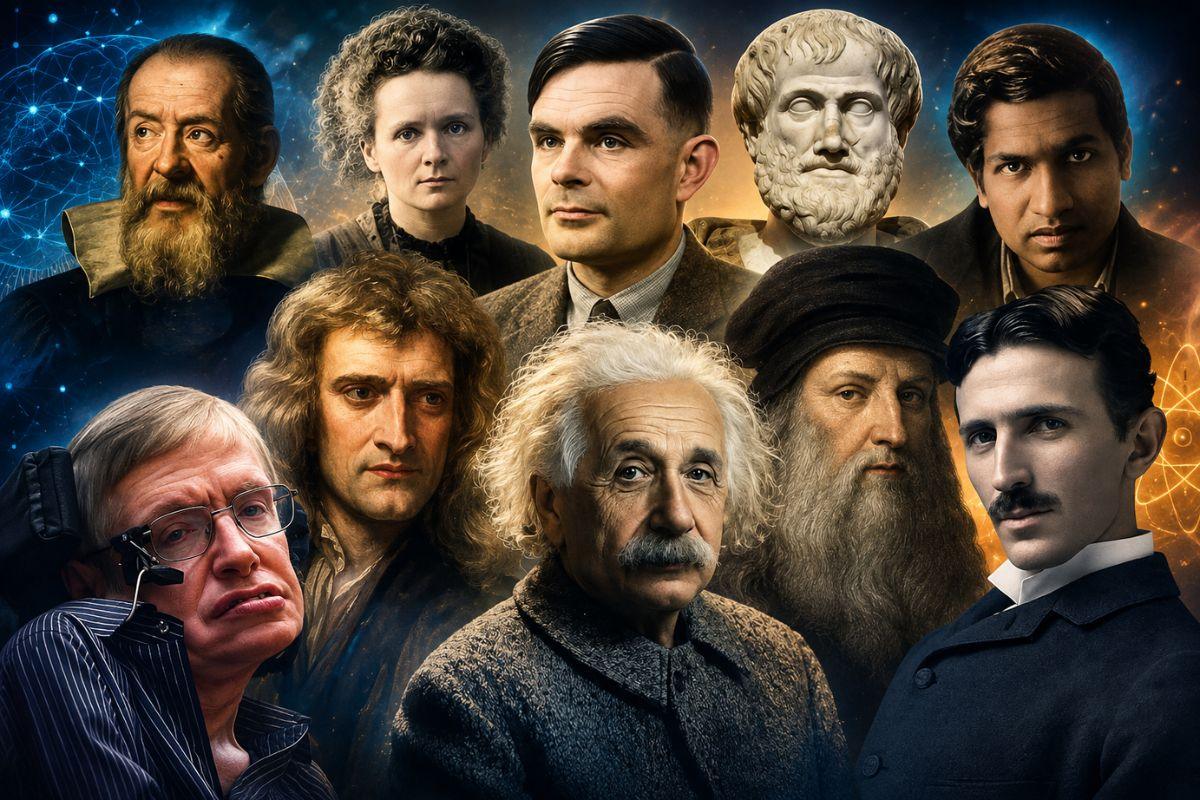
The smartest people on earth? Most people point straight at Albert Einstein, Isaac Newton and Leonardo da Vinci, with a few other cracking minds crashing the party. Ask a room full of people who are the smartest people on earth and, trust me, the same names come flying out.
“Smart” is slippery. Some swear by IQ. Some say it’s creativity. Some reckon it’s what you actually did with all that grey matter. Big Think reckons anything north of 140 is near genius-level—a threshold reached by only 0.4% of the global population, or 1 in every 250 people. Yet most of these legends never sat a single standard IQ test. So those sky-high scores? Educated guesses at best.
- Einstein, Newton and da Vinci are the common names on every “smartest ever” list.
- Nobody agrees on how to measure smarts — IQ, creativity, achievements, take your pick.
- Half of these geniuses lived before IQ tests existed, so their scores are speculation.
- From physics to painting to code-breaking, these people did it all.
Who Are The Smartest People On Earth? The Top 10
You can’t rank smart people like a football league table. One’s a maths wizard, and the next can’t draw a stick man. But we’ve had a crack anyway.
1. Albert Einstein
Of course he’s first. The frizzy-haired icon (1879–1955), a German-born physicist whose surname literally became a byword for “genius”. The relativity theory was his creation. E=mc², the most famous scribble in history, was also his. He helped birth quantum mechanics too. Those are two whole pillars of modern physics with his fingerprints on them. His 1921 Nobel Prize in Physics wasn’t for relativity at all, but for the photoelectric effect.
2. Isaac Newton
Sir Isaac Newton (1643–1727) dropped the Principia in 1687 and basically rewrote the rulebook: the laws of motion and universal gravitation. Why does an apple fall? Why do planets swing round the Sun? He answered both. He co-invented calculus, and in his 1704 book Opticks, he proved that white light is secretly every colour of the rainbow. His ideas stood unbeaten for a jaw-dropping time of over 200 years.
3. Leonardo Da Vinci
Leonardo (1452–1519) is the Renaissance man against whom everyone else is measured. He painted the Mona Lisa and The Last Supper. But flip open his notebooks, and your jaw hits the floor: helicopters, tanks, parachutes, even a rough-and-ready robot — centuries before anyone could dream of building them. His brain research shoved anatomy forward too. Frankly, nobody’s matched his range since.
4. Nikola Tesla
The mad-genius outsider. Tesla (1856–1943), Serbian-American inventor and full-blown futurist. He handed us alternating current (AC) and the induction motor, the devices powering your TV right now. He had around 300 patents to his name. He tinkered with X-rays, radio-controlled gadgets, and wireless power, and he even called smartphones and drones. But after a fight with rival Thomas Edison, he died broke and forgotten, with his beloved Wardenclyffe Tower left half-dreamt.
5. Stephen Hawking
The man who refused to quit. Hawking (1942–2018), an English physicist and cosmologist, was diagnosed with ALS at just 21 and soldiered on for decades. He held the Lucasian Professor of Mathematics chair at Cambridge from 1979 to 2009, the very same seat Newton once warmed. His headline act? Black holes and the mind-bending theory we now call Hawking radiation.
6. Galileo Galilei
The rebel with a telescope. Galileo (1564–1642), an Italian astronomer and physicist who liked to check things himself, thanks very much. He souped up the telescope, clocked Jupiter’s four biggest moons, and championed the outrageous notion that Earth orbits the Sun, not the reverse. The Roman Inquisition branded him a heretic for it. Loads of people call him the father of modern science, and honestly, they’re right.
7. Marie Curie
The queen of the periodic table. Marie Curie (1867–1934), a Polish-French physicist and chemist who smashed every ceiling going. She coined the word “radioactivity” and dug up two brand-new elements, polonium, a nod to her homeland, Poland, and radium. First woman ever to win a Nobel Prize. And still the only person to bag two Nobels in two different sciences, physics and chemistry. Her work fights cancer to this day.
8. Aristotle
The OG brainbox. Aristotle (384–322 BC), Greek philosopher from a spot called Stagira. As per ATI, he studied under Plato, then tutored a young Alexander the Great — talk about a CV. He wrote about basically everything: physics, biology, logic, ethics, politics – the works. A massive slice of Western thought traces right back to him.
ALSO READ: Artificial Intelligence Integration In Modern Organisations: Benefits And Challenges
9. Alan Turing
The wartime hero was robbed of his happy ending. Turing (1912–1954) was an English mathematician and the grandfather of the computer. He cracked the Nazi Enigma code, and History Snob spells out how that saved countless lives. His ideas paved the road to the modern computer. Then, heartbreakingly, after being outed as homosexual, he took his own life in 1954 by eating an apple laced with cyanide. A grim, unfair end for a legend.
10. Srinivasa Ramanujan
The self-taught legend. Ramanujan (1887–1920), an Indian mathematician born into a poor family with barely any formal schooling. Number theory, infinite series, the partition function: he cracked them all, seemingly out of thin air. His notebooks still baffle top mathematicians today. And the kicker? He did every bit of it before dying at just 32.
Who Actually Wins?
Good luck settling that one. From dusty ancient Greece to a buzzing Cambridge lecture hall, this crowd proves what the human noggin can really pull off. Argue the order until the cows come home – people do – but their ideas still run the show and probably will for donkey’s years to come.
FAQs
Q1. Who Is The Smartest Person Of All Time?
Most people shout ‘Einstein’ or ‘Leonardo da Vinci’. Einstein flipped physics on its head, while da Vinci smashed it at both art and science.
Q2. Can You Actually Measure Intelligence?
Not really. IQ, creativity and real achievements all count, so no single number ever tells the full story.
Q3. Who Has The Highest IQ Ever Recorded?
Reports claim child prodigy William James Sidis may have hit 250–300, though it’s fiercely debated. Marilyn vos Savant once held the Guinness record at 228.
Q4. Are The Smartest People Always Scientists?
Nope. Writers like Goethe and Shakespeare, plus thinkers like Socrates and Plato, all sit right up there too.
Q5. Why Is Alan Turing Such A Big Deal?
He busted the Enigma code in the war and dreamt up the ideas behind the modern computer.
Q6. Who’s The Smartest Person Alive Today?
Maths genius Terence Tao gets name-dropped a lot. He’s a UCLA professor with one of the highest IQ scores ever tested.
Sources & References
- Big Think. (2026, May). What IQ scores really mean: Genius level explained. Big Think Media.
- Wikipedia. (2026, April). Albert Einstein. In Wikipedia.
- Stanford University – Department of Philosophy. (2025, December). Aristotle and the foundations of Western thought. Stanford Encyclopedia of Philosophy.
- Cambridge University – Department of Applied Mathematics and Theoretical Physics. (2025, October). Stephen Hawking and the legacy of Hawking radiation. Cambridge Academic Publication.
- National Archives (UK). (2025, August). Alan Turing and the breaking of the Enigma code. GOV.UK Historical Records.
Disclaimer: This article is published strictly for general educational and informational purposes only and does not constitute promotional content, endorsement, or formal academic validation. Historical evaluations of intelligence and IQ estimates vary significantly across biographical sources and scientific consensus. Readers are strongly advised to verify historical facts independently and seek professional guidance or scholarly references before making decisions based on this content.








1 Comment
Alex Chen
Great article, thanks for sharing!