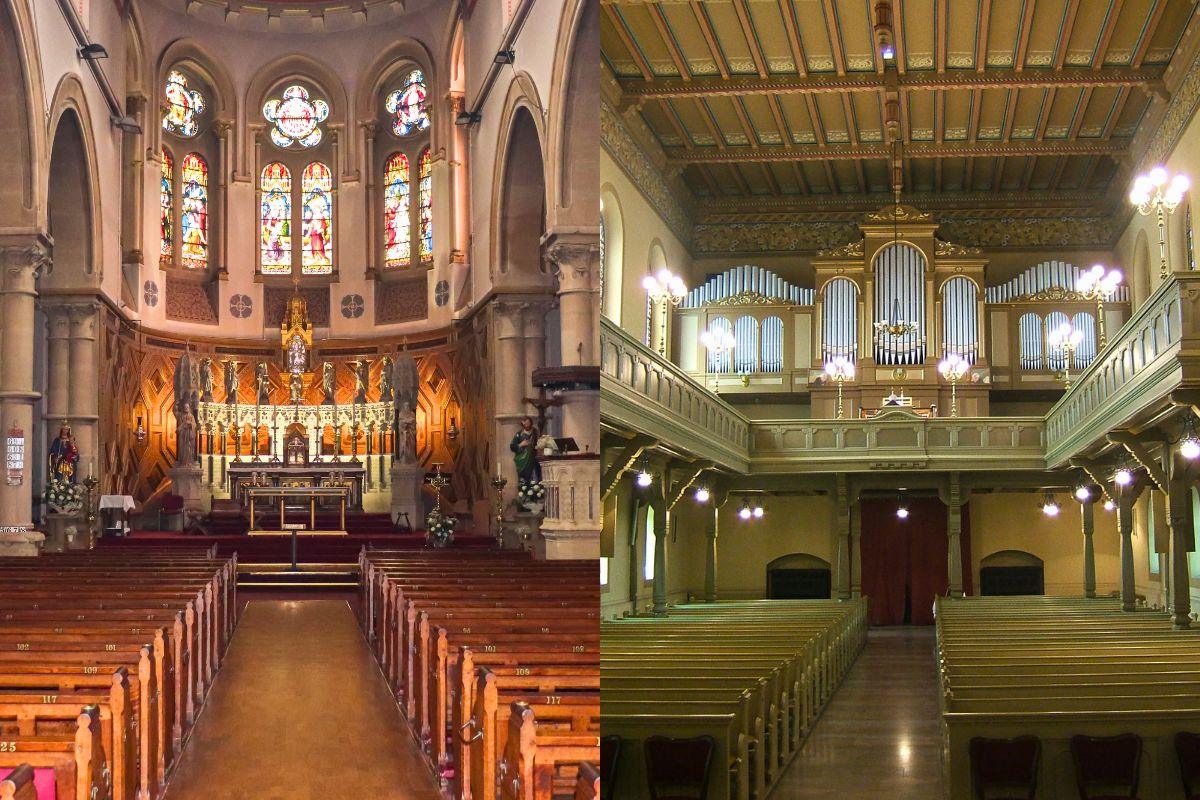
The difference between Roman Catholic Church and Protestant Church teachings is basically authority. Catholics follow the Bible plus Sacred Tradition, with the Pope in charge. Protestants follow the Bible only; there is no Pope, and salvation is a gift you receive by faith.
- The Pope is the head of Catholics. Protestants pray to Jesus Christ only.
- There are 73 books in a Catholic Bible and 66 in a Protestant Bible.
- Catholics practise seven sacraments, while most Protestants have only two.
- Purgatory, saints, and Marian dogmas are Catholic beliefs that reject Protestant beliefs.
- Both still say the Nicene Creed from 325 AD.
Where The Split Actually Began
In Wittenberg, on 31 October 1517. A grumpy Augustinian friar named Martin Luther (1483–1546) nailed 95 complaints on a church door. What made him do that? It was indulgences. Hand over cash, and get your sins rubbed out. Pope Leo X was fine with it because the money was paying for the shiny new St. Peter’s in Rome. Luther thought it stank.
They hauled him in front of the Diet of Worms and told him to take it back. He said no. Then he said he’d reform the whole church while he was at it.
The name came later. “Protestant” comes from the Latin protestatio — a protest letter some Lutheran princes fired off at the Diet of Speyer in 1529. Britain joined it in 1534, when Henry VIII walked out on Rome.
The word “catholic” only means universal, from the Greek katholikos. Ignatius used the phrase “Catholic Church” in writing to Smyrna around 106 AD. And “evangelical”, the other word for Protestant, just means “according to the Gospel”.
Authority: Bible Alone Or Bible Plus Tradition
Protestants go with Sola Scriptura. The Bible is God’s only book, and every teaching gets held up against it. It’s the first of the five solas — Sola Scriptura, Sola Fide, Sola Gratia, Solus Christus, and Soli Deo Gloria — as per Holy Art.
The Catechism of the Catholic Church teaches that Scripture and Tradition pour out of the same wellspring, and only the Magisterium — the Pope, cardinals, and bishops — gets to say what it all means. Handy, because it lets Rome rule on modern stuff the Bible never saw coming.
The gap is literally printed. Luther binned Tobit, Judith, 1 & 2 Maccabees, Wisdom, Ecclesiasticus, and Baruch. He also side-eyed Hebrews, James, Jude, and Revelation. Catholics kept all 73. Catholics traditionally read Douay-Rheims or Knox. Protestants, the King James.
The Pope, Priests, And Who Can Lead
Catholics reckon the Pope—Leo XIV right now—is Peter’s successor, based on Matthew 16:18. The power travels down an unbroken chain called apostolic succession. Papal infallibility on faith and morals was formally defined in 1870. Holy Orders stamps bishops, priests, and deacons with a lifelong seal, and only men qualify for it.
Diffen describes Protestantism simply as Christianity that isn’t under papal authority. Every church runs itself, with pastors, elders and deacons. Luther’s priesthood of all believers means you can confess and receive forgiveness. Women get ordained too — the Church of England said yes to women priests in 1994 and women bishops in 2015.
And there’s no one Protestant church. Try tens of thousands of denominations, officially all equal. They cluster roughly into mainline (Lutheran, Presbyterian, Methodist), Anabaptist (Baptist, Pentecostal, Mennonite, Amish), nontrinitarian, and restorationist.
ALSO READ: Ten Cracking Spots You’ve Got to See in London
Salvation: A Moment Or A Lifelong Process
Protestants believe in one verdict. God calls you righteous because Christ already settled the bill. Ephesians 2:8–9, done. Good deeds come after, out of gratitude, and buy you nothing. Getting holier is sanctification — a different thing, slower.
Catholics believe in a moment and a marathon. It starts at baptism and keeps topping up through grace in the sacraments. The Council of Trent wrote it in Canon 9 — say faith alone justifies and you’re anathema. Trent’s sixth session also said nobody can be dead certain they’ll last the distance. Protestants wave 1 John 5:13 and say, ‘Yes, you can.’
The magazine Voice nails the Catholic setup: grace gets treated almost like a substance, dispensed through channels. So salvation feels less like a signed contract and more like a treadmill.
Sacraments And The Lord’s Supper
Rome’s got seven: baptism, confirmation, the Eucharist, matrimony, penance, holy orders, and anointing of the sick. Wedding customs vary widely across cultures, as this look at East and West engagement traditions shows. Most Protestants keep two — baptism and the Lord’s Supper — and call them symbols you accept by faith.
Now the bread and wine. Catholics hold transubstantiation. The priest speaks, and it genuinely becomes the body and blood. The Mass and Calvary are one single sacrifice. The Host can be prayed to. Non-Catholics? Not invited.
Lutherans go with consubstantiation — Luther compared it to a red-hot iron in a fire, joined but not changed. Baptists and evangelicals take the memorial view: bread stays bread, you’re remembering. In Protestant churches, any baptised person can come to the table and lead it.
Baptism’s another scrap. Catholics christen babies to clear original sin. Baptists and Pentecostals dunk adults who’ve chosen it for themselves. Catholics also grade sin as either mortal or venial, with only mortal sin needing a priest. Protestants go straight to God, though Anglicans say a general confession together during the service.
ALSO READ: Top 7 Things To Do In Scotland For A Truly Epic Adventure
Mary, Saints, Purgatory, And Celibacy
Catholics call Mary Queen of Heaven and Mother of the Church. Immaculate Conception, defined in 1854. Assumption, 1950. The Catechism even calls her Advocate and Mediatrix. Protestants accept the virgin birth, then stop dead.
Saints, same story. Catholics split latria (worship, God only) from dulia (saints) and hyperdulia (Mary) and keep relics, rosaries, crucifixes, and holy water. Statues are fine as inspiration. Protestants smell idolatry and pass. For them, a saint is anyone who trusts Jesus.
Purgatory? Catholic only. Protestants say the cross already covered it, so what’s left to burn off?
Celibacy is compulsory for Latin-rite priests, though Eastern Catholic Churches have married clergy. Luther demanded it be scrapped in 1520, then married a former nun, Katharina von Bora, in 1525. His line: the marriage would please his father, rile the Pope, and make the angels laugh, and the devils weep.
Small Things You’d Spot In The Pews
Catholic Christmas Mass is usually at midnight on 24 December. Protestants often do theirs in the afternoon. On 26 December, Protestants mark the Second Day of Christmas, and Catholics mark Saint Stephen’s Day. Catholics keep Lent, Pentecost and saints’ feast days. Most Protestants keep Christmas and Easter, and that’s the lot. Giving something up for weeks works like any resolution, and habit-building tips can help it stick.
Catholic worship leans on ritual, mystery and liturgy, while a Protestant service builds towards the sermon, as broadcaster DW points out. Music, incense and setting all shape how a space feels, the same principle behind sensory branding. Protestant churches also allow divorce for adultery or abandonment.
Where The Difference Between Roman Catholic And Protestant Churches Stands Today
The Vatican’s Annuario Pontificio counts around 1.406 billion Catholics. Catholic heritage still shapes cities across Italy, from Rome to Venice. The Pew Research Center puts Protestants at near 800 million. The old hatred has cooled right down, and Vatican II’s Decree on Ecumenism even gave the Anglican Communion a friendly nod.
The best reminder comes from the Church of Ireland, which cheerfully calls itself both Protestant and Catholic. “Protestant” is the opposite of “Roman”. Not of “Catholic”.
At-a-Glance: Key Difference Between Roman Catholic Church And Protestant Church
| Feature / Teaching | Roman Catholic Church | Protestant Churches |
| Global Adherents | ~1.406 Billion | ~800 Million – 1 Billion |
| Ultimate Earthly Authority | The Pope (Magisterium) & Sacred Tradition | The Bible Alone (Sola Scriptura) |
| Canon of the Bible | 73 Books (Includes 7 Deuterocanonical books) | 66 Books (Standard Protestant Canon) |
| Number of Sacraments | 7 (Baptism, Confirmation, Eucharist, Penance, Anointing, Orders, Marriage) | 2 (Baptism and The Lord’s Supper / Holy Communion) |
| Doctrine of Salvation | Faith working through love and sacramental grace (Lifelong process) | By grace through faith alone in Christ (Sola Fide) |
| Eucharist / Communion View | Transubstantiation (Real physical presence of Christ) | Memorial / Symbolic or Consubstantiation |
| Clergy & Ordination | Celibate male priesthood (Latin Rite) | Married or single pastors; male & female ordination (varies) |
| Veneration of Mary & Saints | Practised (Intercession requested; Marian dogmas affirmed) | Rejected (Prayer offered to God / Jesus alone) |
Source: Vatican Annuario Pontificio, Pew Research Center (Global Religious Landscape), and Comparative Christian Theology Studies.
FAQs
Q1. Is The Roman Catholic Church Christian?
Yes, obviously. Catholics, Protestants, and Orthodox all worship the same Triune God and believe Christ died and rose.
Q2. Which Came First, Catholic Or Protestant?
Catholic. Protestantism started in 1517, though Protestants insist they were restoring the original church, not building a new one.
Q3. Can A Protestant Take Communion In A Catholic Church?
Normally no. Catholic rules keep it for Catholics. Protestant churches will happily welcome any baptised believer.
Q4. Do Protestants Believe In Purgatory?
No. Heaven and hell only. They say the Bible never spells out a middle stop clearly enough to teach it.
Q5. Is The Church Of England Catholic Or Protestant?
Protestant in belief, Catholic in furniture. Bishops, liturgy, church year — all kept. Papal authority dropped.
Q6. Do Catholics Worship Mary And The Saints?
No. They venerate them and ask for prayers. Worship, in Catholic teaching, goes to God alone.
Sources & References
- Wikipedia. (2026). Catholic Church.
- Wikipedia. (2026). Protestantism.
- Holy Art. (2024). The main differences between Catholics and Protestants.
- Dallas Theological Seminary, Voice. (2023). Del Rosario, M. 7 key differences between Protestant and Catholic doctrine.
- Diffen. (2023). Catholic vs. Protestant.
- Deutsche Welle (DW). (2017). The main differences between Catholics and Protestants.
- Life of Yablon. (2013). You know Giles Coren. Now meet the wife.
Disclaimer: This article is provided strictly for informational and educational purposes only and is not intended for promotional use. The content presented explores historical and theological perspectives surrounding religious practices and denominations. Readers are encouraged to independently verify all facts and seek professional advice or consult qualified religious scholars for specific guidance.