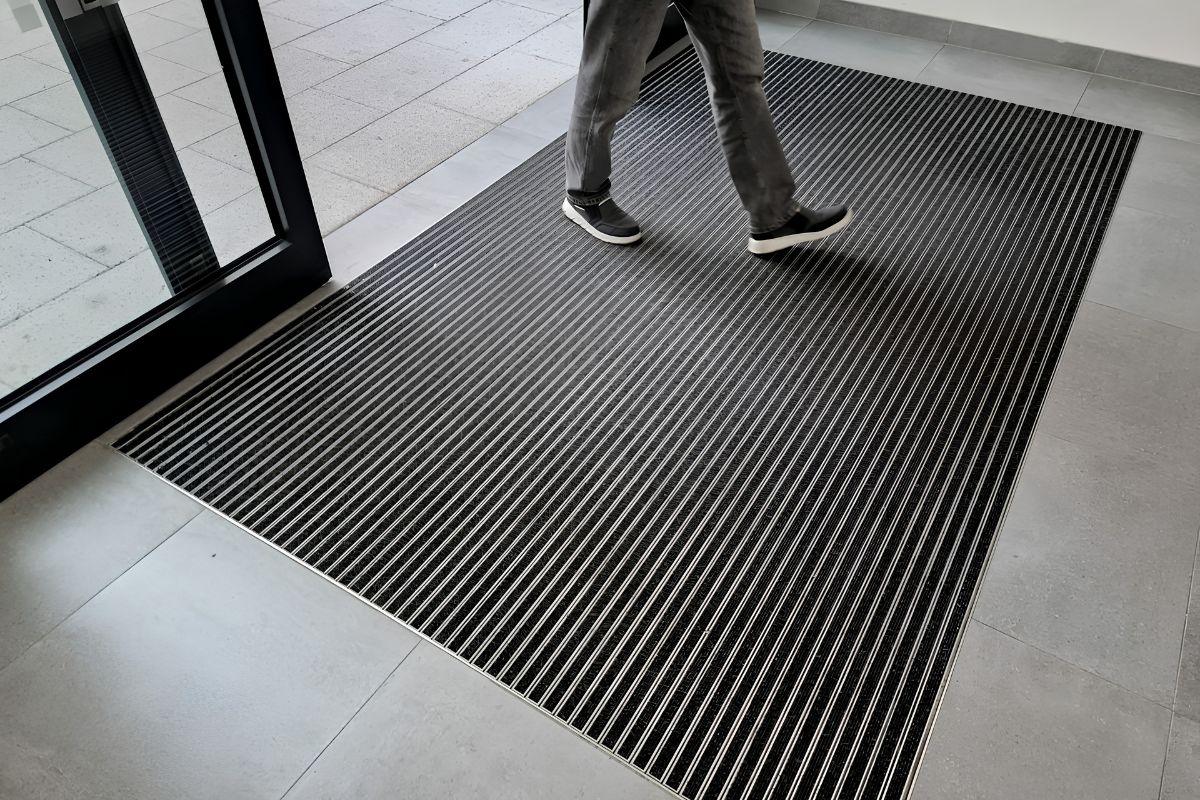
When choosing between a rubber or textile insert, rubber inserts are best for withstanding heavy traffic, sand, and road salt due to their durable, non-porous structure. Textile inserts are designed for drying moisture in secondary entrance stages.
Designing effective entrance cleaning zones for facilities with high pedestrian traffic requires the selection of finishing materials that combine mechanical resistance to abrasion with an effective ability to capture dirt brought in from outside.
- High-traffic entrances require combining durable rubber and absorbent textile inserts to effectively manage dirt and moisture.
- Rubber inserts mechanically scrape off coarse debris like mud and sand while resisting heavy traffic and moisture.
- Textile inserts absorb moisture and trap fine particles but need frequent vacuuming to maintain their cleaning performance.
- Modular entrance matting systems allow specific worn components to be replaced individually to reduce long-term costs.
- Designing a multi-stage entrance zone effectively cleans footwear by sequentially removing coarse dirt, fine particles, and water.
According to the International Sanitary Supply Association (ISSA), roughly 85% of all dirt entering a commercial building is tracked in on foot, with just 1,000 people bringing in 24 pounds (11 kg) of dirt over a 20-day period. During autumn and winter, floors in public buildings, shopping centres and office buildings are exposed to sand, slush and road salt, creating particularly demanding conditions for aluminium profiles and cleaning inserts.
Rubber Vs Textile Inserts – Resistance To Sand And Salt
The choice between an elastomeric insert and a textile surface should be based on the function the individual element is intended to perform within a multi-stage floor protection system. In professional commercial facilities, Durable entrance mats can be based on aluminium profiles fitted with different types of cleaning inserts. Rubber inserts made from materials such as EPDM or vinyl are designed for effective mechanical removal of dirt and are suitable for demanding entrance areas. The manufacturer states that its rubber inserts offer good resistance to abrasion, compression and deterioration caused by moisture.
Textile inserts, on the other hand, can be made from polypropylene or polyamide and are intended to help absorb moisture and retain finer particles that a purely mechanical cleaning surface does not absorb. When exposed to road salt and moisture, textile surfaces require appropriate and regular cleaning to prevent dirt from accumulating within the fibres. For this reason, in entrance areas exposed to coarse sand, grit and road salt, a robust rubber insert can serve as an effective first cleaning stage, while textile inserts can perform the subsequent drying and fine-dirt collection function.
Commercial Entrance Matting Inserts: Technical Performance Comparison
| Insert Material | Primary Function | Moisture Retention Rate | Coarse Dirt & Sand Scraping | Wheeled Traffic Tolerance | Expected Commercial Lifespan |
| Rubber (EPDM / Vinyl) | Heavy scraping & coarse dirt removal | < 0.5 L/m² (Impervious) | Very High (85%+) | Heavy (Trolleys, Carts, Pallet Trucks) | 7–10+ Years |
| Textile (Polypropylene) | Fine dirt trapping & light moisture | 3.5 – 4.0 L/m² | Moderate (40%) | Moderate (Light Carts / Pedestrians) | 3–5 Years |
| Textile (Polyamide / Nylon) | High-capacity drying & fine particle capture | 4.5 – 5.5 L/m² | Low-Moderate (30%) | Moderate (Pedestrian Priority) | 5–7 Years |
| Brush / Strip Cassette | Aggressive mud, grit & snow removal | < 1.0 L/m² | Excellent (90%+) | Heavy (Trolleys & Foot Traffic) | 6–8 Years |
How Does A Rubber Insert Handle Heavy Traffic And Dirt?
The ribbed surface of a rubber insert works by mechanically loosening dirt from the soles of footwear as people walk across it. The profile structure helps remove compacted mud, sand and other coarse particles, directing them into the spaces between the profiles. The resistance of the rubber material to mechanical wear makes this type of insert suitable for demanding entrance areas.
The properties that make rubber inserts useful in such conditions include:
- Resistance to abrasion and compression – rubber cleaning inserts are designed to withstand repeated mechanical contact and pressure during everyday use.
- Mechanical cleaning properties – the profiled surface helps remove coarse dirt such as sand and mud from footwear.
- Suitability for wheeled traffic – Unimat offers entrance matting systems designed to handle pedestrian traffic as well as cleaning wheels, including shopping trolleys and other wheeled equipment.
- Resistance to moisture – the manufacturer’s information confirms good resistance of rubber inserts to deterioration caused by moisture.
ALSO READ: How Rooflights Improve Natural Daylight Distribution
Advantages And Limitations Of Textile Inserts In High-Traffic Areas
Textile inserts with dense fibres are an important element of interior cleaning zones where drying footwear and retaining fine particles are priorities. Polypropylene and polyamide fibres can help retain moisture and dirt within the structure of the mat. This means that a dense textile surface can help prevent wet footprints from being transferred further into the building, provided that the entrance system is appropriately selected and maintained.
One limitation of textile inserts is that they can become filled with fine sand and other particles when they are used without an effective preliminary cleaning stage. Fine particles can penetrate between the fibres and contribute to abrasion during repeated use.
The consequences of inadequate moisture control extend beyond floor wear: in 2024, 844 U.S. workers died in falls, accounting for 17% of all workplace deaths, and nearly 480,000 were injured badly enough to require days off work, as stated by National Safety Council, a category in which wet or contaminated entrance flooring is a recognised contributing factor. Properly selected durable entrance mats with a modular or multi-stage structure can therefore help protect interior floors from dirt and moisture, but textile inserts require regular cleaning to maintain their effectiveness.
Maintenance And Durability – Which Insert Should You Choose For Long-Term Use?
Assessing the service life of an entrance system requires consideration of both ongoing maintenance costs and the ease of servicing individual components. The stakes are not only cosmetic: road salt tracked in from winter conditions is highly corrosive, and in the wider infrastructure context rock salt’s corrosive effects on cars, trucks, bridges, and roads result in approximately $5 billion dollars in annual repairs in the U.S. alone as per U.S. EPA report, illustrating why entrance profiles and inserts exposed to the same chloride-laden slush need to be genuinely salt- and moisture-resistant rather than merely decorative.
Aluminium profiles form the structural basis of many entrance matting systems, while the cleaning inserts are the elements that are subject to normal wear. Proper maintenance of profiles and cleaning inserts depends on the type of material used:
- Cleaning rubber inserts – regular removal of accumulated sand and dirt helps maintain their cleaning performance. The specific cleaning method should follow the manufacturer’s recommendations for the particular system.
- Maintaining textile inserts – regular vacuuming is important for removing accumulated dirt and particles, while periodic deeper cleaning helps remove moisture, salt and other residues retained in the fibres.
- Resistance to cleaning chemicals – different materials have different cleaning requirements, so the cleaning products recommended for a particular insert should be used rather than assuming that the same agents are suitable for every material.
- Replacing worn modules or inserts – modular entrance mat systems can make it possible to replace individual damaged elements rather than replacing the entire cleaning zone. The Unimat 17 Modulus system, for example, consists of individual 30 × 30 cm modules that can be replaced separately.
Recommendations: Choosing A Durable Entrance Mat For Demanding Conditions
In facilities with heavy pedestrian traffic, an effective approach is to create a sequence of cleaning zones or combine different types of inserts. Combining rubber with textile or brush elements allows the entrance system to perform different cleaning functions at successive stages. Unimat’s technical guidance recommends using more than one type of doormat in larger buildings and describes minimum, classic and optimal cleaning-zone configurations.
When designing an entrance area for a shopping centre, railway station, office building or hospital, a multi-stage cleaning zone can be used to progressively remove coarse dirt, finer particles and moisture:
- Zone 1 – outside the building: cleaning systems such as aluminium mats with rubber inserts, grilles or other exterior cleaning solutions can remove coarse snow, mud, sand and grit.
- Zone 2 – entrance hall or vestibule: a combination of cleaning and drying surfaces can reduce finer particles and remove moisture from footwear.
- Zone 3 – main lobby or reception area: textile drying mats can collect remaining moisture and fine particles before they reach the main floor surface.
- Areas exposed to wheeled traffic: entrance systems with appropriate reinforced profiles and support should be selected where shopping trolleys, wheelchairs, hand pallet trucks or other wheeled equipment regularly pass through. Unimat specifically offers systems designed for both pedestrian and wheeled traffic.
The dimensions of the cleaning zone should be selected according to the actual conditions of the entrance, including traffic intensity, available space, the type and amount of dirt and the expected type of traffic. Rather than applying one fixed length to every facility, the cleaning sequence should be designed to match the specific entrance. Unimat provides individually dimensioned entrance mats and can produce systems adapted to the geometry and technical conditions of a particular site.
If you are planning to modernise or equip a new entrance area, the manufacturer’s technical team can help determine an appropriate configuration of profiles and cleaning inserts and prepare a solution suited to the requirements of the project.
ALSO READ: The Role of Asset Valuation in Business Financial Planning
FAQs
Q1. What Is The Difference Between Rubber And Textile Entrance Mat Inserts?
Rubber inserts scrape off coarse mud and sand mechanically, whereas textile inserts absorb moisture and trap finer dust particles.
Q2. How Does A Multi-Stage Entrance Cleaning Zone Work?
It uses three progressive zones to remove heavy outdoor grit outside, dry footwear in the vestibule, and catch remaining fine dirt in the main lobby.
Q3. Can Commercial Entrance Matting Systems Handle Heavy Wheeled Traffic?
Yes, reinforced aluminium profile systems are specifically designed to support shopping trolleys, wheelchairs, and hand pallet trucks alongside heavy pedestrian traffic.
Q4. Which Entrance Mat Insert Is Best For Sand And Road Salt In Winter?
Robust rubber inserts are ideal for winter conditions because they resist moisture damage while effectively scraping away abrasive sand, grit, and salt.
Q5. How Do You Properly Maintain Aluminium Entrance Mats For Long-Term Use?
Vacuum textile inserts daily, remove trapped debris from rubber profiles regularly, and swap out individual worn modules instead of replacing the entire system.
Sources & References
- U.S. General Services Administration. (2026, July). Flooring and entrance matting standards for public buildings. GSA.gov.
- Health and Safety Executive. (2026, May). Preventing slips and trips in workplaces: Guidance on entrance matting systems. HSE.gov.uk.
- Wikipedia. (2026). Entrance mat.
- Building Research Establishment. (2025, December). Durability of flooring materials: Abrasion and moisture resistance in commercial facilities. BRE.ac.uk.
- Chartered Institute of Building. (2025, August). Best practice in designing entrance cleaning zones for high‑traffic buildings. CIOB.org.uk.
Disclaimer: This article is provided solely for general informational and educational purposes and does not constitute brand promotion, commercial endorsement, or professional engineering advice. The information regarding facility entrance systems, technical configurations, and materials should be independently verified prior to procurement. Readers are advised to seek professional advice from certified architectural and facility management specialists to suit their specific requirements.