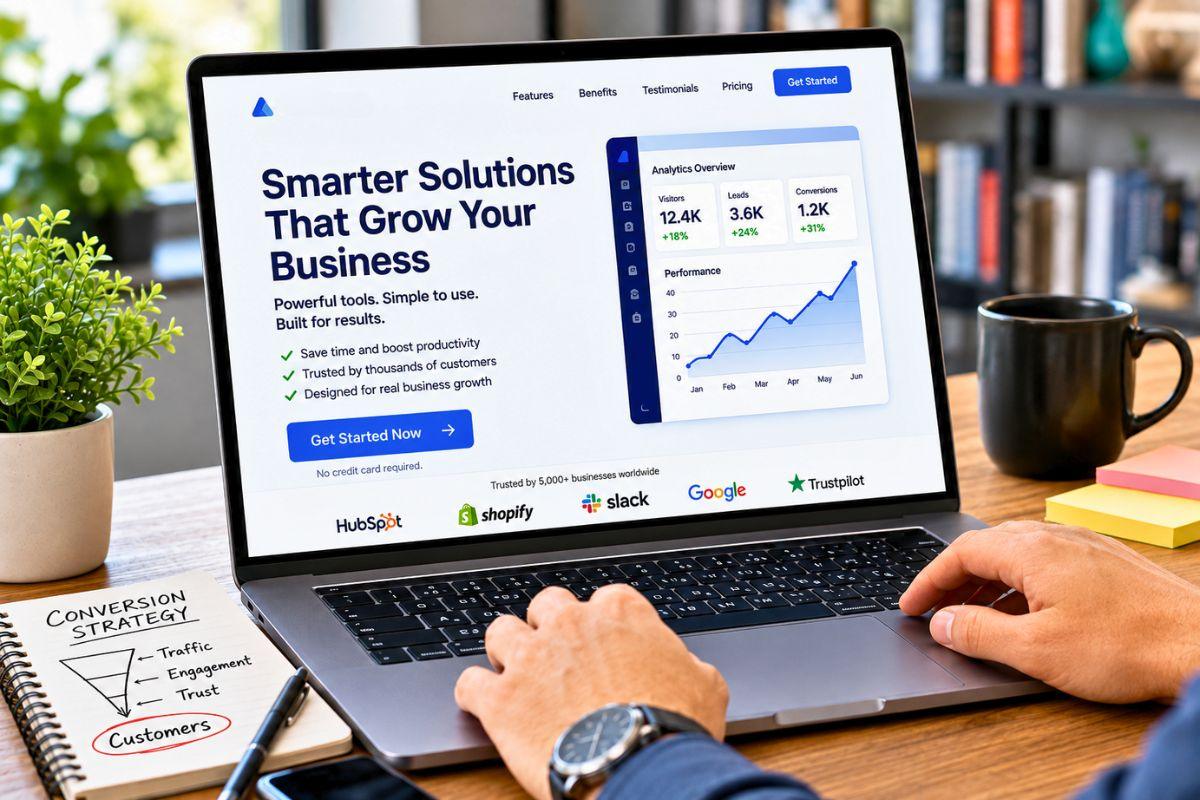
Getting someone to click your advert is only half the battle. The real challenge starts when they land on your landing pages. You’ve got seconds to give them what they came for, or, with another click, they’ll be gone.
- A landing page must deliver on the exact promise made in the original advertisement.
- Using a single call to action prevents user confusion and increases conversions.
- Page content and offers must match the specific funnel stage of the visitor.
- Eliminating friction like slow load speeds and complex forms prevents lost conversions.
- Tracking conversion and bounce rates helps identify and fix page performance issues.
Why Some Clicks Don’t Convert
A landing page has one job: converting one user, with one aim, into one action. Unlike a homepage, which is built to serve many different visitors and interests at once, a landing page can’t give a user a choice. Do that, and they’ll choose to leave.
The good news, however, is that deciding on the action you want a user to take is easy. It’s the same action you promised in your ad or email. A landing page’s only job is to deliver on that promise, using the exact same language and tone of the ad.
ALSO READ: 7 Top Tools to Help Local Businesses Get Found on Google
Some more good news is that if you’re looking to optimise your landing pages but don’t know where to start, working with a pay per click advertising London agency can help take the guesswork out of improving pages that aren’t converting.
Earning A Click’s Trust
Every element on the landing page needs to reinforce the promise that won you the click. This is most important in the headline, which needs to quickly tell users they’re in the right place. Again, the copy beneath the headline needs to focus on the same outcome, as does the social proof. If your testimonials and reviews aren’t speaking to the specific hesitations holding a user back from making the one decision you want from them, then they’re not doing their job.
Competing CTAs split attention and confuse users. Remember, landing pages aren’t multiple choice. They need one CTA, repeated as often as it needs to be, without having to compete against another one.
ALSO READ: Music For Businesses: Sensory Branding And The Strategic Role Of Sound In Customer Experience
Matching The Page To The Funnel Stage
You need to appreciate that users can come to you at any stage of the consumer journey. Treating every click as if it’s after the same thing is another way a landing page can underperform.
- A top-of-the-funnel visitor needs a low-commitment offer. A guide or something more informational, paired with copy that educates and builds awareness, rather than selling.
- A middle-of-the-funnel visitor needs more proof. They’re ready for more details about your brand, maybe even a free trial. But what they’re not ready for is a hard sell.
- A bottom-of-the-funnel visitor is someone ready to make a decision. This is where your landing page needs to be most aligned around one specific call to action. A direct, transactional page with as little friction as possible makes sense here.
A beautifully designed, well-written page isn’t enough to convince a cold prospect if you’re asking for too much too soon. Get the stage wrong, and you’ll find your landing pages underperform.
What Kills A Conversion
Message mismatch is the big one we’ve covered, but there are others. Competing CTAs or even slow-loading pages can stop a click from becoming a customer. Things like poor mobile optimisation or overly complex forms are the small problems that show up again and again to kill otherwise good landing pages.
Fix the easily overlooked mistakes, and you might see the right results start to compound: more sales and leads from the same traffic, lower cost-per-acquisition, and a stronger first impression for your brand.
ALSO READ: How Quality Promotional Videos Increase Conversions and Brand Trust
Optimise For The Moment Of Decision
Once you’ve nailed the fundamentals, you’ll find that improving your landing pages becomes about removing friction. Site speed and mobile optimisation matter, as a massive part of your traffic will be on their phones, with no time for slow pages.
When it comes to A/B testing landing pages, begin with your headline and your CTA, as these carry the most weight. But remember, don’t be tempted to try to sneak in more messages.
What To Measure
There are three numbers that tell you most of what you need to know:
- Conversion rate is the headline metric. This is the one that ultimately defines whether the page is doing its job.
- Bounce rate and time on page are early diagnostic signals that can explain why a landing page isn’t converting.
- Form abandonment rate pinpoints exactly where in the process visitors are dropping off.
ALSO READ: Artificial Intelligence Integration In Modern Organisations: Benefits And Challenges
A Quick Checklist
Before you send traffic to a landing page, run through these:
- Does your headline promise the exact same thing as the ad or email that got the click?
- Is there one CTA, and only one?
- Does your form match how much trust you’ve earned at that funnel stage?
- Have you tested your headline and CTA yet?
- Would the page still make sense on a phone, on a slow connection?
- Do your testimonials speak to the specific hesitation stopping someone from converting?
Get these right, and you’ll stop losing customers to the small stuff, converting more clicks into the customers your business needs.
Sources & References
- Google Analytics Academy. (2026, June). Measuring landing page performance: Conversion, bounce, and abandonment rates.
- Wikipedia. (2026). Landing page.
- HubSpot. (2025, December). Optimising landing pages for funnel stages: Awareness, consideration, and decision.
- Stanford University – Graduate School of Business. (2025, October). Digital advertising effectiveness and landing page design.
Disclaimer: This article is provided for informational purposes only and is not intended for promotional or commercial endorsement. The strategies discussed should be evaluated based on individual business goals and requirements. Readers are advised to verify all facts independently and seek qualified professional advice before implementing any digital marketing strategies.