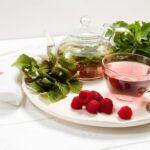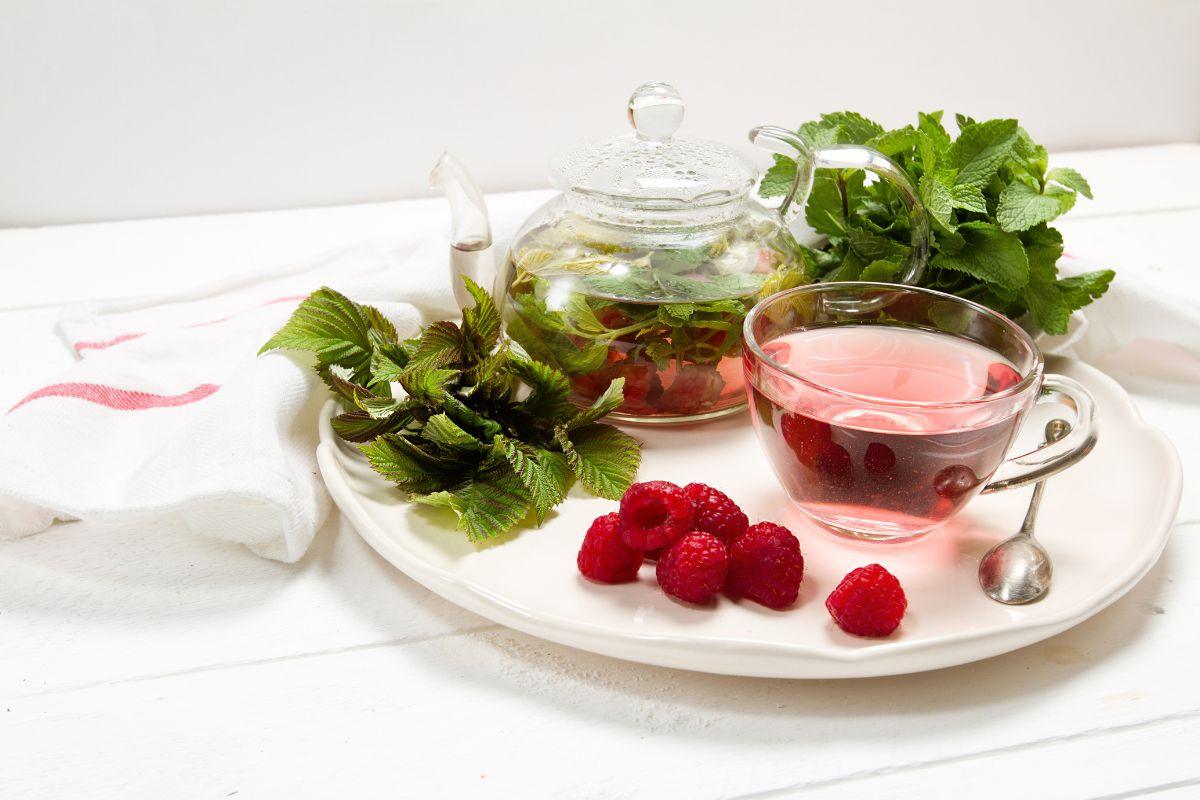
Dried leaves of the red raspberry plant, brewed like tea. No caffeine, no fruity flavour. Put 2–3 g into 250 ml of boiling water, leave for five to ten minutes, and stop at three cups a day.
Raspberry leaf tea smells of hay and drinks like weak builder’s tea. By week two, it can become a daily habit.
- It’s the Rubus idaeus leaf, not the berry, with zero caffeine.
- The flavour is earthy, grassy, slightly drying, and never fruity.
- Use 2–3 g per 250 ml for five to ten minutes, one to three cups daily.
- Pregnant or on medication? Ask your midwife or GP first.
What Is Raspberry Leaf Tea?
It is a tisane, with no Camellia sinensis in it. The plant belongs to Rosaceae, the same family as roses and apples. People have dried these leaves since the 1500s, long before “wellness” labels existed. Count the leaflets: five to seven, toothed, silvery-white underneath. Healthline notes it’s native to Europe and parts of Asia, where the leaves have long been used medicinally.
Raspberry Leaf Tea Properties And Nutrition
A cup has no calories or macronutrients. WebMD lists it as a good source of magnesium and calcium and an excellent source of potassium, which helps to manage healthy blood pressure and lower stroke risk.
It also has iron, manganese, and vitamins C, E, and B. It also has antioxidants like ellagitannins, hydroxybenzoic acids, and anthocyanins, plus flavonoids like quercetin and kaempferol. A little ellagic acid has anticancer effects in test tube studies. That dry feel on your tongue? Tannins make up at least 5% of the dried leaf. Plus fragarine, an alkaloid found only in Rubus plants.
ALSO READ: Ultimate Healthiest Food Picks You Should Add to Your Plate Every Day
What Does It Taste Like?
It is mild, grassy, and a bit drying. The closest match is light Ceylon, or weak Darjeeling. Nothing floral, nothing sweet, and no berries. If you brew it properly, there will be no bitterness. In twenty minutes, the tannins go dry, like stewed black tea.
Supermarket trap: “raspberry tea” on a British shelf is nearly always a fruit blend — hibiscus, rosehip, apple pieces, and flavouring. Read the label: you want “raspberry leaf” as the first ingredient.
What You Need
Loose-dried leaf, a kettle, filtered water, a fine-mesh infuser, a teapot, and a cafetière. The bits sail through cheap strainers. Scales help; the leaf is feather-light, so a tablespoon weighs about 2g.
How To Brew Raspberry Leaf Tea Drink
- Boil fresh water at a full 100°C. Hardy leaf, it needs the heat.
- Weigh 2–3 g per 250 ml. Two for gentle, three for proper.
- Pour straight over the leaf.
- Wait five to ten minutes. Five is light, and ten is deep and earthy. Seven’s the sweet spot.
- Strain, then drink plain or with a little honey.
Simple Loose Leaf recommends fresh spring water, never re-boiled — twice-boiled tastes flat. You can also use distilled water. Tap water goes muddy. Don’t leave the infuser in your mug. The second steep works with two or three extra minutes; skip the third. Milk? Tried it. Too delicate to cope, so green rooibos is your friend.
Iced And Cold Brew
For iced tea, brew a concentrate of 5–6 g per 250 ml for eight to ten minutes over a full glass of ice, with lemon or mint to lift it. For cold tea, brew a concentrate of 4–5 g per 500 ml cold water, lid on, and fridge for eight to twelve hours. Finely cut leaf pulls faster and can turn bitter, so taste at eight.
Blends Worth Trying
Neutral base blends well. Try peppermint at two parts leaf to one part mint for five to seven minutes. Hibiscus at three to one is ruby red and tart. Nettle equal parts, lemon balm two to one, plus chamomile or ginger.
How Much Should You Drink?
One to three cups a day. No official UK figure exists, so start with one. Since it’s caffeine-free, an evening cup is a gentle way to wind down, and it pairs well with getting enough deep sleep.
When To Start Drinking Raspberry Leaf Tea
Hold off until roughly 36 weeks of pregnancy, then have one cup a day, up to three by 39 weeks. Birthly points out that by the third trimester the womb is well developed, so cramping is less likely. Some midwives abroad reckon 32 to 34 weeks. Hate the taste? Tablets: one daily, two from 39 weeks. Early pregnancy: leave it. Some herbalists warn it can stimulate the uterus.
Does It Actually Work?
The evidence is thin. A 2001 trial in the Journal of Midwifery & Women’s Health found that the tablets did no harm to either mother or baby but did not significantly shorten labour.
A 2024 study of 91 pregnant women — 44 on raspberry leaf, 47 not — logged fewer epidurals, instrumental births and caesareans among users, plus more vaginal births and shorter labours.
A 2021 review in BMC Complementary Medicine and Therapies found very little evidence that it makes childbirth easier. A 2023 review in Nutrients said the same: research was limited, and side effects were included. Midwives use it anyway: a survey of the American College of Nurse-Midwives found that 63% used it to induce labour, and 21% reported complications: early labour, prolonged contractions, nausea, and vomiting.
Not pregnant? Plenty of people sip it for PMS cramps, nausea, and diarrhoea — that’s just word of mouth. The milk-supply claim hasn’t held up in trials, though leaf polyphenols do reach breast milk. The “detox” weight-loss pitch? One study found no effect.
Side Effects And Who Should Avoid It
Nothing dramatic: softer stools (it’s a mild laxative) and more trips to the loo. It may mimic oestrogen. Home remedies are tempting, but they can backfire when you don’t know how they work. The NHS warns herbal remedies can clash with some medicines, including diabetes drugs and antidepressants.
Ask your midwife first if you have high blood pressure, twins or a breech baby, a history of miscarriage or premature labour, placenta praevia or any complication, a booked caesarean, you’re breastfeeding, or breast or ovarian cancer, endometriosis or fibroids in the family. Spotting or Braxton-Hicks after a cup? Stop.
Buying And Storing
Always use whole or coarsely cut loose leaf. Good stock is muted green on one side, silvery-grey on the other, and has a faint hay smell. Brown, dusty, or musty means warehouse time. Go organic, since you’re steeping the leaf directly; most decent stock comes from Poland, Bulgaria, or Albania. Airtight jar, out of light and heat, used within 12 to 18 months.
ALSO READ: Does Matcha Have Caffeine? Things Every Matcha Lover Should Know
FAQs
Q1. Does Raspberry Leaf Tea Taste Like Raspberries?
Not even slightly. It has a mild, earthy, grassy, and closer taste to a light black tea.
Q2. Does Raspberry Leaf Tea Contain Caffeine?
None whatsoever, so it’s fine at bedtime or if you’re off caffeine.
Q3. How Long Should I Steep Raspberry Leaf Tea?
Five to ten minutes in freshly boiled water. Five keep it light, and ten make it strong.
Q4. Can Raspberry Leaf Tea Bring On Labour?
Not on its own. No solid evidence shows it starts labour, but many drink it to prepare for labour.
Q5. Can I Drink Raspberry Leaf Tea If I’m Not Pregnant?
Yes, it’s a mild daily brew. Some use it for period cramps, but it is anecdotal.
Q6. Is Raspberry Leaf Tea Safe For Everyone?
No. Skip it in early pregnancy, with certain conditions, or alongside some medicines.
Sources & References
- Healthline. It’s native to Europe and parts of Asia, where the leaves have long been used medicinally.
- WebMD. It is a good source of magnesium and calcium and an excellent source of potassium.
- Simple Loose Leaf. Use fresh spring water and never re-boil it, as twice-boiled water tastes flat.
- Birthly. By the third trimester, the womb is well developed, so cramping is less likely.
Disclaimer: This article is published for informational purposes only and is not intended as a promotion or medical endorsement. Readers are advised to independently verify facts, consult healthcare professionals, and seek expert medical advice before making any health-related decisions.