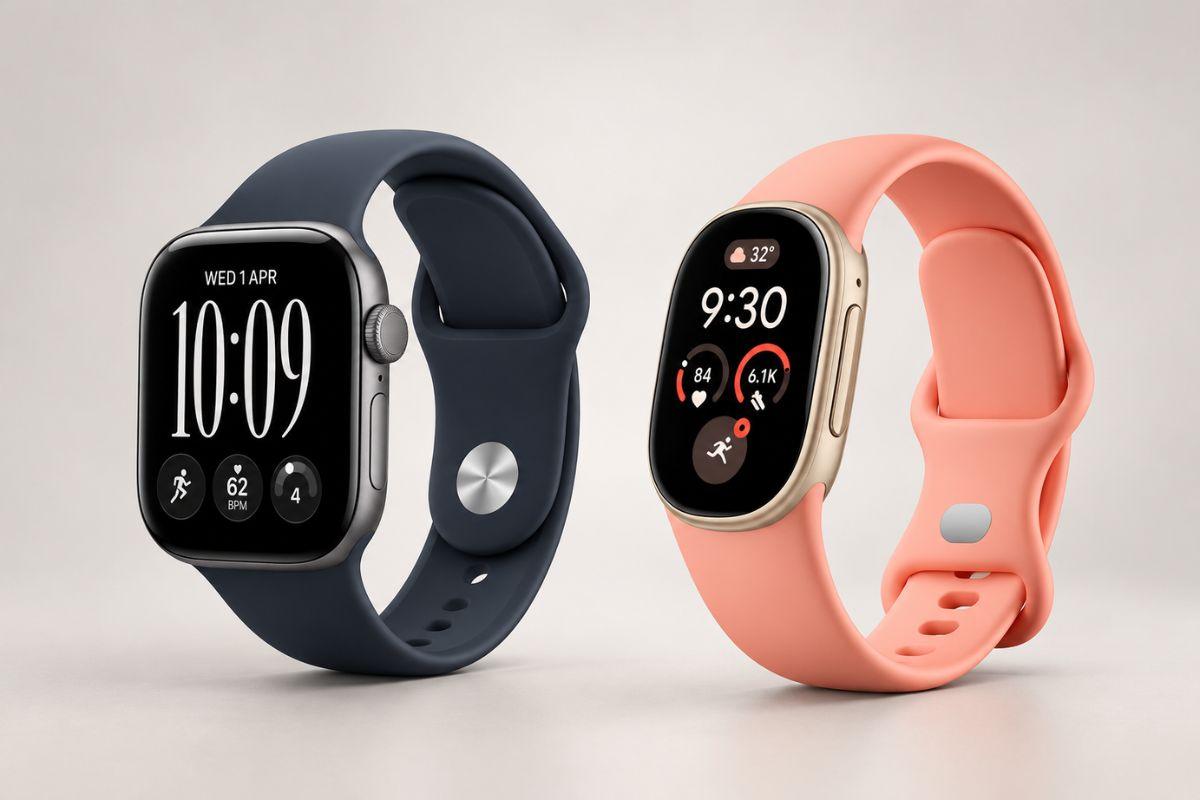
Apple Watch Series 12 vs Google Fitbit Edge has many key differences. But choosing between them isn’t really about picking a “winner.” It comes down to what you actually want strapped to your wrist every day. Short version: the Series 12 is Apple’s full smartwatch, built for iPhone owners who want calls, apps and deep health tracking on their arm.
The Fitbit Edge, on the other hand, is a slimmer, cheaper tracker with a week of battery and most of the key health sensors, minus the bells and whistles. Both launched within weeks of each other in autumn 2026, so this comparison is unusually well timed — and, oddly enough, that timing makes the decision harder, not easier.
- Price gap: Series 12 starts at $399 / £369; Fitbit Edge starts at $179.99 — less than half as much.
- Battery life: Series 12 lasts up to 24 hours; Fitbit Edge is rated for up to 7 days.
- Phone calls and apps: Series 12 takes calls and runs an App Store. Fitbit Edge has no microphone or speaker at all.
- Compatibility: Series 12 needs an iPhone. Fitbit Edge works with Android and iOS alike, which counts for a lot.
- Weight: Fitbit Edge is roughly 45% lighter than the Series 12, and that difference is noticeable overnight.
Apple Watch Series 12 Vs Google Fitbit Edge: Specs At A Glance
| Feature | Apple Watch Series 12 | Google Fitbit Edge |
| Starting price | $399 / £369 | $179.99 (~£145) |
| UK release | September 2026 | October 2026 |
| Battery life | Up to 24 hours (38 hrs Low Power Mode) | Up to 7 days |
| Fast charge | 15 min = 12 hrs use; 5 min = 10 hrs sleep tracking | 5 min = 1 full day of use |
| Weight | 39.5g (42mm aluminium) | 17.7g (without band) |
| Display | Always-On OLED, 2,000 nits | Always-on OLED touchscreen |
| Heart rate | Continuous, sampled every 5 seconds | Continuous monitoring |
| ECG | Yes | Yes |
| GPS | Built-in GPS, GNSS | 40% more accurate than earlier Fitbit trackers |
| Sleep tracking | Yes, with sleep stages | Yes, 15% more accurate stage detection claimed |
| Calls & apps | Yes — calls, Siri, App Store | No — no microphone or speaker |
| Phone compatibility | iPhone 11 or later, iOS 27+ | Android and iOS |
| Water resistance | Water resistant (varies by case) | IP68, rated to 50 metres |
| AI coaching | Workout Buddy (Apple Intelligence) | Google Health Coach (Gemini), needs Premium |
Source: Technical specifications compiled from official product documentation via Apple Watch Official Specifications and Google Store Fitbit Official Specs
Prices and specs are correct as of October 2026 and can shift depending on region, case size and retailer. Worth double-checking before you buy, basically.
Battery And Charging
Apple rates the Series 12 for up to 24 hours of normal use. That stretches to 38 hours in Low Power Mode, and outdoor workout tracking now lasts up to 10 hours, which is a decent bump over last year. A 15-minute top-up buys you 12 hours of everyday use. Five minutes on the charger, and you’ve got enough juice for 10 hours of sleep tracking — handy if you forget to plug in before bed, which, let’s be real, happens to everyone eventually.
The Fitbit Edge plays a completely different game. Google says its 65mAh battery lasts up to seven days on one charge. Five minutes on the magnetic charger covers a full day’s use, and a complete charge takes roughly 90 minutes. No daily ritual required.
That’s the trade-off in a nutshell. The Series 12 needs charging every single day, but it does far more in return. The Edge needs charging about once a week. It asks less of you day to day, and for some people that’s the whole appeal.
Health And Fitness Tracking
Both watches take health seriously, just from different angles. The Series 12 introduces a new Health Sensing System. It checks your heart rate continuously, every five seconds, rather than the periodic sampling used on the Series 11 — a small change that adds up over a day of wear. It also splits HRV into two separate readings: a Recovery HRV for daily stress and readiness, plus a longer-term reading for cardiovascular trends.
The Fitbit Edge covers similar ground. Continuous heart rate monitoring, a built-in ECG app, overnight skin-temperature sensing, and sleep-stage analysis that Google claims is 15% more accurate than earlier Fitbit devices. Built-in GPS is also said to be 40% more accurate, which actually matters if you are running or cycling outdoors on a regular basis.
Where the Series 12 pulls ahead is depth and breadth, plain and simple. Apple’s Vitals app, Blood Oxygen readings, ECG app and Workout Buddy coaching (powered by Apple Intelligence) all sit on top of a far wider third-party app ecosystem than Fitbit can currently match.
It’s worth zooming out here, because the wearables category itself is in a strange place right now. Global smartwatch shipments actually fell 4% year-over-year in the second quarter of 2026, according to Counterpoint Research, as buyers held onto older devices longer and the cheap, basic-tier segment kept shrinking.
The research firm points to longer replacement cycles as a sign the market is maturing, which is making life harder for manufacturers trying to push new models. Apple, interestingly, bucked that trend: its shipments climbed 14% in the same quarter, and the Apple Watch now holds roughly 40% of the global smartwatch market, up from around 38.5% a year earlier.
ALSO READ: Apple iOS 27 Release: Essential Features You Need To Know
Design, Comfort And Everyday Use
This is really where the two devices part ways. The Series 12 is a proper smartwatch. You can take calls, reply to texts, use Apple Pay, ask Siri and install third-party apps, all without pulling your phone out of your pocket — which, once you get used to it, is hard to give up. It weighs around 39.5g in the 42mm aluminium case, rising to roughly 52.9g in the ceramic finish.
The Fitbit Edge, at just 17.7g without its band, is roughly 45% lighter than the Series 12. It has an OLED screen for notifications, Google Maps directions, music control and activity stats. But there’s no microphone or speaker, so phone calls simply aren’t an option here. It’s built for people who want fewer demands on their attention, not more, and honestly, that’s a legitimate design choice, not a missing feature.
Price And Who Each One Suits
The Series 12 starts at $399 (£369). The Fitbit Edge starts at $179.99, with a Stephen Curry Special Edition priced at $219.99. That gap matters. The Edge costs under half as much and still covers most of the health tracking people actually use day to day, which raises a fair question about how much the extra money on the Apple side is really buying you.
If you’re already in Apple’s ecosystem, want calls and messages on your wrist, and don’t mind charging nightly, the Series 12 is the straightforward pick. If you’d rather forget about charging for most of the week, don’t need a full smartwatch strapped to your arm, and want something lighter for sleep tracking and workouts, the Fitbit Edge makes more sense. And crucially, it works with both Android and iPhone, so it doesn’t lock you into one ecosystem the way Apple’s watch does.
The Wider Smartwatch Market In 2026
A few numbers help put this comparison in context. The table below pulls together some recent industry figures from Counterpoint Research, just to show where these two devices sit inside a bigger, somewhat bumpy market.
| Market stat (Q2 2026) | Figure |
Global smartwatch shipments, YoY change | Down 4% |
Apple’s global smartwatch market share | ~40.2% |
Apple’s shipment growth, YoY | Up 14% |
Series 11 + SE 3 share of Apple’s shipments | Over 80% |
China’s share of global shipments | 38% (record high) |
Forecast full-year 2026 market growth | ~1% |
Forecast market CAGR through 2030 | ~3% |
Source: Market statistics compiled from the official Counterpoint Research Global Smartwatch Market Intelligence
None of this changes which watch is right for you, but it does explain a bit of the backdrop. Shipments overall have slowed partly because people are holding onto their existing watches longer, and the cheaper, basic-tier segment keeps shrinking.
Premium devices, meanwhile, are the part of the market still pulling in buyers — which is roughly where both the Series 12 and the Fitbit Edge are aiming, just from opposite price points.
So in the end, it’s less about which watch “wins” and more about which habits you’re willing to build around. Daily charging and deep integration, or a week of freedom and a simpler toolset. Either way works. It just depends on you.
ALSO READ: Can a Cold Plunge Really Help You Burn Body Fat? – Explained
FAQs
Q1. Is The Google Fitbit Edge A Smartwatch Or A Fitness Tracker?
It’s a hybrid, really. Google positions it between the screenless Fitbit Air and the full Pixel Watch 5. It has a screen for notifications and maps, but no calls, apps or microphone.
Q2. Does The Fitbit Edge Work With An iPhone?
Yes. It supports both Android and iOS, unlike the Apple Watch Series 12, which only works with an iPhone.
Q3. How Much Longer Does The Fitbit Edge’s Battery Last Than The Apple Watch Series 12?
Google claims up to seven days versus Apple’s 24 hours. That’s roughly seven times longer between charges, which is a big gap no matter how you slice it.
Q4. Can The Apple Watch Series 12 Make Phone Calls Without An iPhone Nearby?
Yes, on cellular models with an active wireless plan. The Fitbit Edge has no microphone or speaker, so it can’t make or take calls at all.
Q5. Which Is Better Value, The Apple Watch Series 12 Or The Fitbit Edge?
The Fitbit Edge costs under half the price and still covers most core health tracking. The Series 12 costs more, but it adds calls, apps and deeper health sensing — so “better value” really depends on what you’ll actually use.
Sources & References
- Apple Watch Series 12 tech specs — Apple Support. Backs the case weights (39.5g aluminium, 52.9g ceramic) and the 15-minute charge for 12 hours of use.
- Apple Watch Series 12 — John Lewis product listing. Backs the 24-hour and 38-hour Low Power Mode battery figures and the iPhone 11 or later requirement.
- Apple Watch Series 12 Cheat Sheet — TechRepublic. Backs the $399 starting price, the 10-hour workout battery and the September on-sale date.
- Apple Watch Series 12: Everything you need to know — iGeeksBlog. Backs the unchanged $399 price and the 10-hour outdoor workout battery, a 25% boost on last year’s model.
Disclaimer: The content provided in this article is intended strictly for general informational and educational purposes only and does not constitute promotional material or formal purchasing advice. While every effort has been made to ensure accuracy at the time of publication, product specifications, prices, and availability are subject to change. Readers should independently verify all facts, features, and pricing details with official sources and seek professional guidance before making any purchasing decisions.