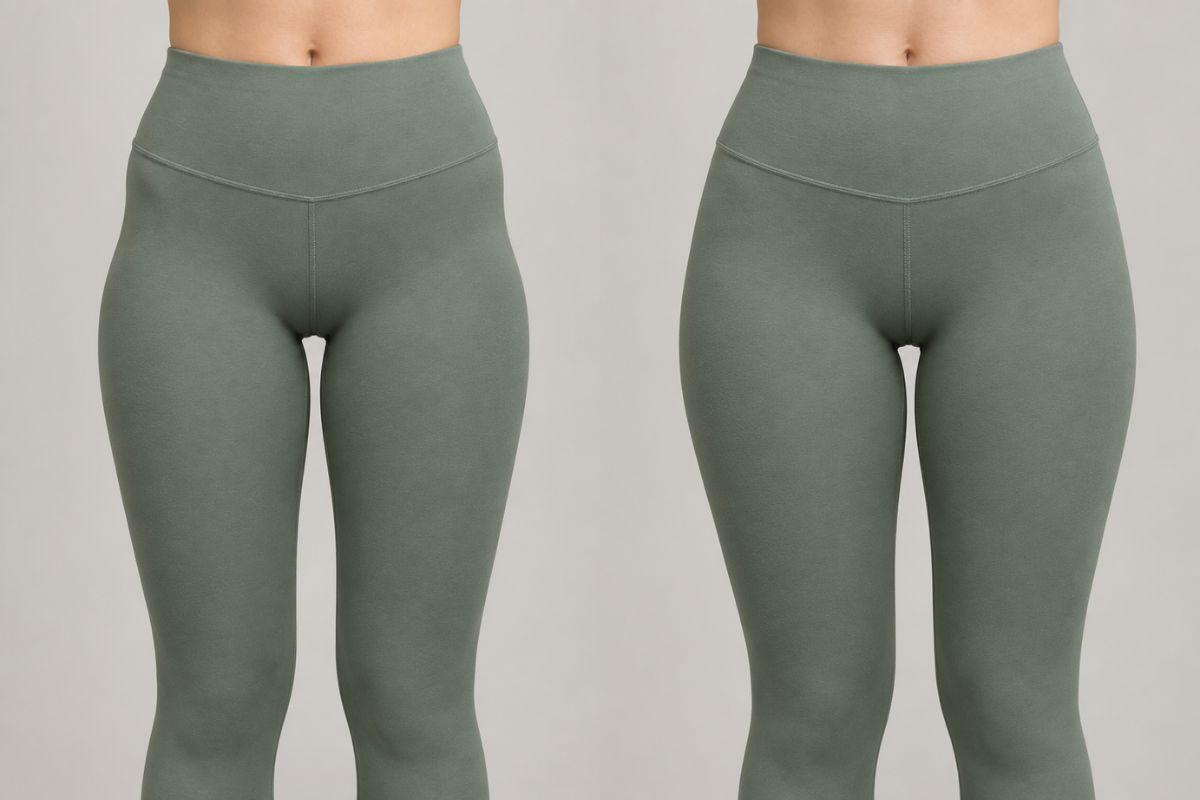
Hip dips are natural inward curves on the outer hips, just above the thighs. Your bone structure causes them, not your weight or fitness. They are normal and harmless. Exercise cannot remove them, but fillers or fat transfer can soften how they look.
Noticed a small inward curve where your hip meets your thigh? You are not alone. So, what are hip dips, and should you worry about them? Read to learn more.
- Also called violin hips or trochanteric depressions.
- They sit between the top of the pelvis and the thigh bone.
- Your skeleton sets them, not diet or training.
- They pose no health risk.
What Are Hip Dips?
Hip dips are small dents on the outer line of the hips. Instead of a smooth curve from waist to thigh, the outline dips inward, like the waist of a violin, hence the name “violin hips”.
You will not hear the term from your GP, as it is not a medical phrase. Health coverage on TODAY.com links the recent fixation to TikTok, where influencers push workouts and diets that claim to “fix” them.
What Causes Hip Dips?
Your skeleton is the main cause. The top of your pelvis, the ilium, forms the first curve. The top of your thigh bone, the greater trochanter, forms the second. Muscle and fat between them curve inward and create the dip.
Dr. Julia Iafrate, a sports medicine physician at NYU Langone Health, explains, “The more broad or wide the ilium is compared to the greater trochanter, that is going to make somebody potentially have hip dips”.
Hip width, femoral neck length, fat storage, glute size, and genetics all affect how visible they are. This phenomenon is why hip dips often run in families. Muscle and fat can deepen or soften the look, but they do not cause it.
ALSO READ: Escape To Your Own Home Spa: A Step-By-Step Guide To Creating A Soothing Environment
Are Hip Dips Normal?

Yes. They can appear in lean people, curvy people, athletes, and people who never exercise. They are more common in women, as the female pelvis is shaped to carry a baby, but men have them too.
Exercise physiologist Katie Lawton at Cleveland Clinic puts it simply: “Hip dips are nothing to be worried about, but it may be worth considering modifications for certain exercises if you have them”. Hip dips are not love handles, which are fat stored on the sides of the waist.
Do Hip Dips Ever Go Away?
So, can you get rid of hip dips? Not fully. No diet or workout changes your skeleton. Spot reduction, burning fat from one area, does not work either. Losing weight can even make the dips look deeper, as less fat covers them.
Exercises For Hip Dips

Training will not erase the dips, but strong hips can help ease back, knee, and hip pain and lower injury risk. Building the gluteus medius, the muscle just above the dip, may add a little volume. Yorkville’s physios recommend checking with a physio first.
- Clamshells: lie on your side, knees bent, and lift the top knee.
- Side-lying leg raises: lift the straight top leg, then lower slowly.
- Glute bridges: lie on your back and lift your hips.
- Curtsy lunges: step one leg diagonally behind the other.
- Fire hydrants: on all fours, lift one bent knee sideways.
- Hip thrusts and squats: build overall lower-body strength.
Results take months, and deep dips may barely change. “Side plank hip dips” is a core move and does nothing for hip shape.
How To Get Rid Of Hip Dips: Treatment Options
- Dermal fillers: Hyaluronic acid adds volume straight away, with little downtime. Results last roughly 12 to 24 months and can be dissolved.
- Fat transfer: Fat is removed by liposuction, cleaned, and injected into the dips. Around 60–70% usually survives; the rest is reabsorbed over the first three months. Premier Vein & Body calls it the most popular choice with its patients. You need enough spare fat.
- Hip implants: Silicone implants are permanent but riskier and can move or form scar tissue.
- Body contouring: Non-invasive devices like truSculpt iD smooth the area, with results after about three months.
- 360 liposuction: This technique slims the waist above the dip rather than filling it.
In 2025, the UK government announced plans to limit high-risk procedures, such as liquid BBLs, to qualified healthcare professionals. Check that your surgeon is on the GMC register and that the clinic is CQC-regulated.
Hip Dip Treatment Options: Key Comparison Benchmark
| Treatment Method | Procedure Type | Longevity / Results | Typical Downtime | Est. UK Cost Range (£) | Key Advantage / Trade-off |
| Hyaluronic Acid Fillers | Non-Surgical (Injections) | 12 – 24 months (Temporary) | 1 – 2 days | £1,500 – £3,500 | Immediate results, dissolvable; requires periodic top-ups |
| Autologous Fat Transfer | Surgical (Liposuction + Grafting) | Long-term / Permanent (60–70% fat survival) | 1 – 2 weeks | £4,500 – £7,500 | Uses natural fat, dual body-contouring benefit; requires donor fat |
| Silicone Hip Implants | Surgical (Incision & Placement) | Permanent | 2 – 4 weeks | £6,000 – £9,000 | Guaranteed volume regardless of weight; higher risk of displacement |
| Non-Invasive Contouring (e.g. truSculpt) | Non-Invasive (Energy Device) | Gradual (3+ months for full result) | None (Immediate return) | £1,000 – £2,000 | Zero downtime or needles; subtle, mild smoothing effect |
Source: Synthesized from UK Aesthetic Clinic Pricing Benchmarks, British Association of Aesthetic Plastic Surgeons (BAAPS), and Care Quality Commission (CQC) registered provider guidance.
How Much Does Hip Dip Surgery Cost?
Price depends on the liposuction needed, the volume of fat moved, and anaesthetic and facility fees. The Centre for Surgery in London confirms prices at consultation and offers 0% APR finance for procedures over £1,500. Fillers cost less upfront but need top-ups.
ALSO READ: Deep Tissue Massage: Everything You Need To Know About
Recovery After Hip Dip Surgery

Fat transfer is usually a day case lasting two to three hours. Most people:
- Take one to two weeks off work
- Wear compression garments for four to six weeks
- Avoid sitting on their hips early on
- See the final shape after three to six months
When To See A Doctor
Hip dips need no treatment. But pain, stiffness, or limited movement deserves a check. Orthopaedic surgeons note these signs may point to hip impingement or muscle imbalance.
FAQs
Q1. What Are Hip Dips?
Hip dips are inward curves on the outer hips, between the pelvis and thigh bone. They come from your skeleton and are a normal body shape.
Q2. Are Hip Dips Normal?
Yes. They are very common in women and appear in men too. They are not linked to weight or fitness and cause no health problems.
Q3. Can Exercise Get Rid Of Hip Dips?
No. Exercise cannot change bone shape. Building the glutes may soften the dip slightly and will make your hips stronger.
Q4. Do Hip Dips Mean I Am Overweight?
No. Slim and larger people both have them. Losing weight can even make them more visible, as less fat covers the area.
Q5. What Is The Best Treatment For Hip Dips?
Fat transfer gives the longest-lasting result for most suitable patients. Fillers are suitable for people who want a quick, temporary, non-surgical option.
Q6. How Long Does Hip Dip Recovery Take?
Most people return to work within one to two weeks after fat transfer. Final results show after three to six months.
Sources & References
- Cleveland Clinic. (2026). Hip dips: What they are and whether they matter. Cleveland Clinic Health Essentials.
- Yorkville Sports Medicine Clinic. (2026). Hip dips: What are they and the exercises to reduce their appearance?
- Premier Vein & Body. (2026). What are hip dips and how can you get rid of them?
- Centre for Surgery. (2026). What is hip dip surgery? Centre for Surgery.
Disclaimer: The information provided in this article is for educational and informational purposes only and is not intended as medical advice, diagnosis, treatment, or promotion of any medical procedure or product. Content regarding hip dips, exercises, and cosmetic procedures should not replace professional medical guidance. Readers are strongly advised to independently verify all medical facts and seek advice from a qualified healthcare provider before undertaking any treatments or lifestyle changes.