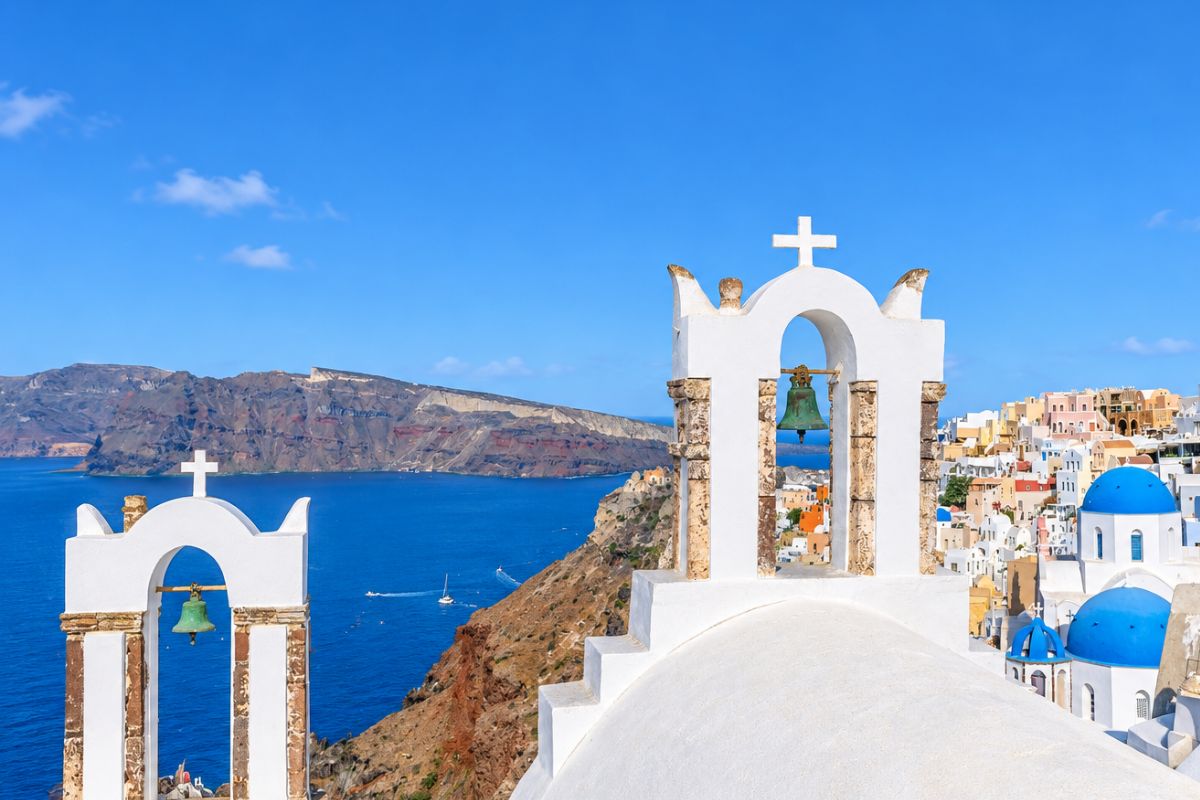
Greece’s best-known island group, called the Cycladic Islands, is located in the Central Aegean Sea, southeast of Athens. It has around 220 islands and islets, of which about 24 are lived in all year. Expect white cube villages, clear water, ancient ruins and short ferry hops between them.
If the postcard version of Greece lives in your head like blue domes, sun-bleached alleys, or a small boat bobbing below, you are picturing the Cycladic Islands. Each one has its character, from party-hard Ios to near-silent Anafi. That variety is the point, and it is why so many British travellers return year after year.
- There are around 220 islands and islets, but only about 24 of them have permanent residents.
- Naxos is the largest island. Syros has the biggest population and holds the capital, Ermoupoli.
- Six islands have airports: Mykonos, Santorini, Paros, Naxos, Milos and Syros.
- Ferries sail from three Athens ports: Piraeus, Rafina and Lavrio.
- Late September and October bring warm sea, thinner crowds and lower prices.
- Milos and Santorini are volcanic. The rest are peaks of a sunken mountain range.
How Many Islands Are In The Cyclades?
Counts differ because nobody agrees where an islet ends and a rock begins. The usual figure is about 220. Wikipedia names the main ones: Amorgos, Anafi, Andros, Antiparos, Delos, Ios, Kea, Kimolos, Kythnos, Milos, Mykonos, Naxos, Paros, Folegandros, Serifos, Sifnos, Sikinos, Syros, Tinos and Santorini. A string of Lesser Cyclades lies between Naxos and Amorgos. Four of them have residents: Donousa, Irakleia, Koufonisia and Schinoussa.
Britannica puts the land area at 976 square miles (2,528 sq km). The old Cyclades prefecture recorded 119,549 residents in the 2005 census. That prefecture was abolished in the 2011 Kallikratis reform and split into nine regional units. Naxos is the biggest island at roughly 390 sq km, and Mount Zas on Naxos, at 1,004 m, is the highest point in the group.
ALSO READ: What to Do in Venice Italy: A Travel Guide to Exploring the Floating City
Why A Circle Gave Them Their Name
“Kyklos” means “circle” in Greek. The islands sit in a rough ring around tiny Delos, and that ring gave them their name. Delos was sacred ground. Legend says Leto gave birth to Apollo and Artemis there. By the 5th century BCE, it held the treasury of the Athenian-led Delian League. The whole island is now an archaeological site and a UNESCO World Heritage Site.
The human story runs far deeper. A Neolithic culture took root in the western Aegean before 4000 BCE. From around 3300 BCE, the Early Cycladic period produced those flat marble figurines you see in museums, carved centuries before Minoan Crete rose.
In 1898–99, Christos Tsountas excavated burial sites across several islands and coined the term “Cycladic civilisation”. Later, looters stripped many sites, so we may never fully understand the meaning of the figurines.
How To Get To Cyclades Islands
Most UK travellers fly to Athens first, then fly on or sail from there, and it is worth setting aside a day or two for the things to do in Athens before you head out to the islands.
Summer direct flights from Britain land at Mykonos, Santorini and Paros. Olympic Air and Aegean fly from Athens to Mykonos, Santorini, Paros, Naxos, Milos and Syros, usually in under 45 minutes. Every other island needs a boat.
Ferries leave from Piraeus, Rafina and Lavrio. Piraeus is the easiest to reach and serves nearly every island in high season. Rafina suits Andros and Tinos and is often quicker straight from Athens airport. Lavrio covers Kea and Kythnos, and Kea is only about 40 minutes away. Santorini, Anafi and Amorgos are the furthest out, taking seven to ten hours from Piraeus on a slow boat.
The main operators are Blue Star Ferries, Hellenic Seaways, SeaJets, Golden Star and Minoan Lines. High-speed catamarans halve the journey and roughly double the fare. A guide written by Greece-based experts suggests checking a ferry aggregator rather than each company in turn.
One warning. When the wind reaches Force 8, sailings stop. Never book the last ferry before your flight home.
Which Cycladic Islands Suit You Best?
- Beaches: Milos has over 40 beaches along a lace-like coast, including moon-white Sarakiniko and geothermally warmed Paleochori. Naxos offers long golden sand at Plaka, Agios Prokopios and Agios Georgios.
- Nightlife: Mykonos and Ios are the top choices. Paros gives you bars and clubs in Naoussa and Parikia for less money.
- Walking: Andros has roughly 300 km of trails and is listed among Europe’s leading quality trails. Some Sifnos paths date back to 3000 BCE, when miners and farmers first trod them. A lazy day on the Andros trails adds up quickly, and it is an easy way to hit 10,000 steps a day without noticing.
- Food: Sifnos is the gastronomic star. Try chickpea fritters, slow wood-oven cooking and the island’s famous pottery.
- Peace And Quiet: Folegandros, Sikinos, Anafi, Kimolos and the Lesser Cyclades. Anafi has about 330 residents and three ferries a week.
- Culture: Syros is the administrative capital, with neoclassical Ermoupoli and mediaeval Ano Syros above it. Tinos draws pilgrims to Panagia Evangelistria, built after an icon of the Virgin Mary was found on 30 January 1823.
When To Go, And What It Costs
Peak season runs from mid-June to early September. It is hot, with average highs near 32°C, and it is busy and dear. The meltemi wind blows hardest in July and August. It cools the air, but it can also ground ferries.
Shoulder season is better. Greeking, a Greek tour operator, flags April, May, September and October as the best months for mild 15–27°C days and smaller crowds. The sea is at its warmest in early autumn. Between November and March, many smaller islands shut much of their tourist infrastructure. If winter sun is the goal, our pick of the best warm places to visit in Europe in the UK winter has better bets.
On money, budget around €100–300 a night for a three- or four-star room in peak season. A taverna lunch runs about €25 a head, a mid-range dinner €30–35, a cocktail €8–12, a bus ticket €2 and a hire car €30–100 a day. Ferry fares start near €30 and climb to €150 on fast, long routes.
ALSO READ: Ten Cracking Spots You’ve Got to See in London
Facts Worth Knowing Before You Fly
The islands are drowned mountain peaks. Soil is poor almost everywhere except Naxos, so farming is limited to wine, fruit, wheat, olive oil and tobacco. Mykonos is said to have 365 chapels, one for each day of the year. Tinos has over 1,000. Greece Moments, a German Greece specialist, points out that the Portara gate on Naxos weighs 65 tonnes and is all that survives of an unfinished temple of Apollo.
Santorini owes its shape to the Minoan eruption around 1600 BCE. It is a Decade Volcano, still monitored, and last erupted in 1950. Roughly 16,000 people live there, and over three million visit each year. Greece as a whole draws far more, and our guide to the world’s most visited countries shows how it compares. Amorgos holds the Hozoviotissa monastery, founded in the 9th century and reached by 300 steps. Luc Besson filmed The Big Blue there in 1988.
Pack water shoes for pebbly bays and sturdy soles for rocky paths. Leave your heels at home. Cards work in hotels and most restaurants but carry euros in cash for taxis, kiosks and the smaller islands. Sort your data before you fly too, because an eSIM can keep you online on the ferries and help you avoid roaming charges.
FAQs
Q1. Which Cycladic Island Is Best For A First Visit?
Naxos or Paros. Both have airports, strong ferry links, good beaches and real villages. Santorini and Mykonos are stunning, but they can be crowded and expensive in the summer.
Q2. How Many Days Do You Need In The Cyclades?
Seven to ten days is the sweet spot. That covers two to four islands without losing whole days to the boats. Allow three days per island.
Q3. Are The Cyclades Expensive?
Mykonos and Santorini are among Greece’s dearest islands. Tinos, Syros, Sikinos, Amorgos and Anafi cost far less, especially outside July and August.
Q4. Can You Island Hop Without A Car?
Yes. Naxos, Paros and Santorini have decent buses, and taxis cover the gaps. Hire a car or scooter only if you want to beach hop properly.
Q5. Which Cycladic Island Has The Best Beaches?
Milos for drama and variety, with over 40 beaches. Naxos for long stretches of soft golden sand that suit families.
Q6. Do You Need To Book Ferries In Advance?
In July and August, yes. Popular routes sell out, and locals travel too. In spring and autumn, you can usually book a few days in advance.
Disclaimer: This article is provided solely for general informational purposes and is not intended for promotional use. Readers are encouraged to independently verify facts, check current travel updates, and seek professional guidance before making any travel plans or bookings.