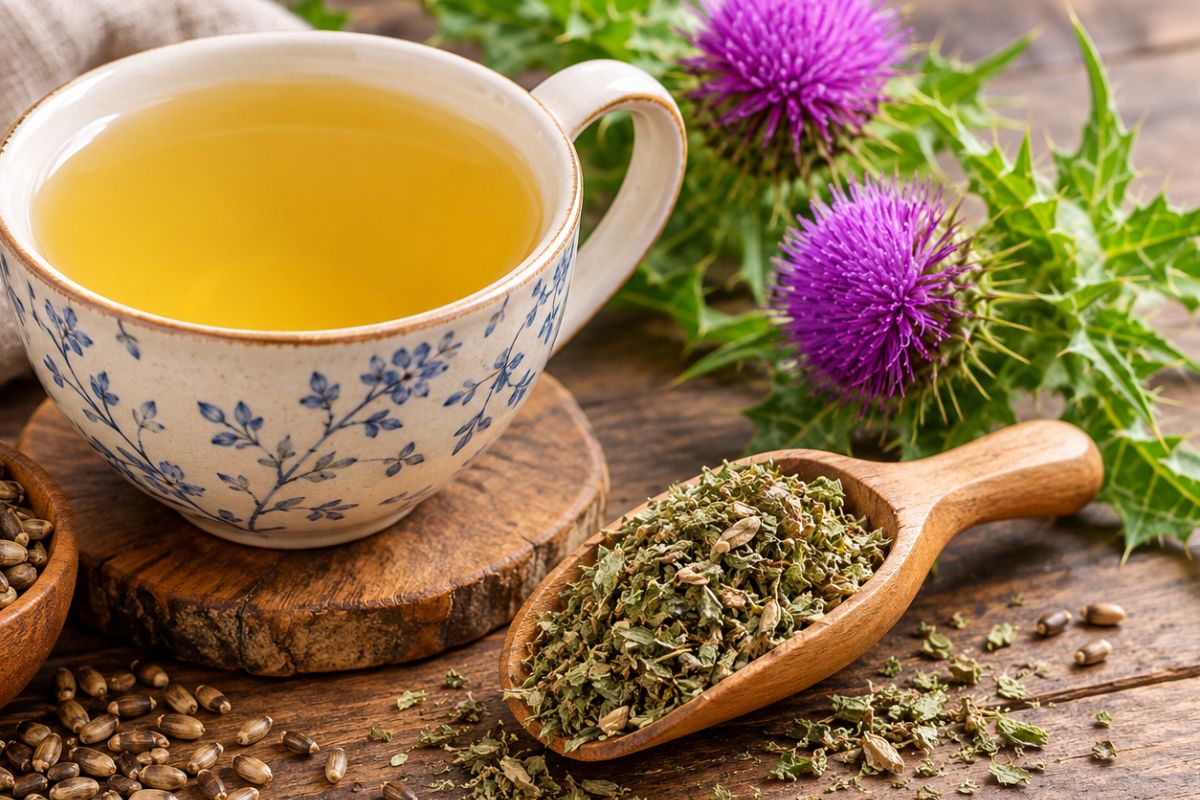
Milk thistle tea is a caffeine-free herbal infusion made from the seeds or leaves of Silybum marianum. People drink it to support the liver, blood sugar, and skin. Its active compound, silymarin, barely dissolves in water, so the tea is far weaker than a capsule.
Tall, thorny, and purple-flowered, the plant carries milky white veins on its leaves. The legend says a drop of the Virgin Mary’s milk made those streaks.
- Silymarin is the active compound group, and it sits mostly in the seeds.
- Liver health is the best-studied use, yet human results stay mixed.
- Silymarin dissolves poorly, so tea is far weaker than extracts.
- Most guidance points to 1–2 cups a day.
- Avoid in pregnancy, with hormone-sensitive conditions, or with some medicines.
What Is Milk Thistle Tea?
Milk thistle tea is from the Asteraceae family, so daisies and sunflowers are relatives. Native to the Mediterranean, it now grows almost everywhere, Britain included, and also sells as Saint Mary’s thistle, holy thistle, or Scotch thistle.
The Greek physician Dioscorides (40–90 AD) is thought to be the first to write about its healing properties, and herbalists carried it on for liver and gallbladder complaints. Healthline describes a mild flavour close to dandelion tea; seeds taste earthier and slightly bitter.
ALSO READ: Magnesium Deficiency Explained: Symptoms, Causes, Muscle Twitching, And Headaches
Milk Thistle Tea Ingredients
Most of your cup is water. WebMD says milk thistle tea is not a significant source of any major nutrients, vitamins or minerals, as whatever leaches out stays dilute.
Silymarin is a mixture led by silybin, along with isosilybin, silychristin, isosilychristin, silydianin and taxifolin. It appears in the flowers and leaves but concentrates in the seeds, clinging to the outer coat.
Seeds also carry vitamin E plus potassium, calcium, phosphorus and chloride, and the tea matches green tea for antioxidants. Unlike green tea or matcha, which both contain caffeine, this brew stays completely caffeine-free. Silymarin is poorly absorbed and not water-soluble.
Milk Thistle Tea Benefits
Beth Czerwony, a dietitian at Cleveland Clinic, sets the tone. “Milk thistle is interesting because from what we know, it might be beneficial for people with various health problems,” she states. “The problem is that it hasn’t been very well studied in people yet. So, it’s hard to recommend as a safe or effective remedy.”
Liver Support
Researchers have called milk thistle “the most well-researched plant in the treatment of liver disease.” It is used alongside care for alcohol-related liver disease, fatty liver disease, hepatitis, and liver injury from drugs or toxins such as death cap mushroom amatoxin.
It is thought to mop up free radicals, slow scarring and stop toxins binding to liver cells. A 2014 review found it may extend life expectancy in cirrhosis from alcohol-related liver disease, and Pharmaceutical Biology published work showing it cut liver damage in mice. Human trials are messier.
The National Center for Complementary and Integrative Health funded two studies on hepatitis C and non-alcoholic steatohepatitis, and neither showed a benefit. Diet counts for liver health too, so it makes sense to pair any herbal habit with some of the healthiest foods you can find.
Blood Sugar And Diabetes
In one trial of people with diabetes and alcoholic cirrhosis, 600 mg of silymarin daily for six months reduced fasting and mean daily glucose without extra hypoglycaemic episodes. A 2016 review found a significant drop in fasting blood sugar but rated those studies as of low quality. A 2025 review tempers that silymarin appeared to benefit insulin sensitivity, yet had no detectable effect on insulin levels or blood sugar. Phytotherapy Research also linked it with lower total and LDL cholesterol.
If you take diabetes medication, the evidence is mixed. Hypoglycaemia is dangerous, so monitor your levels and ask your GP first. Daily habits matter more than any single herb, and regular movement, such as hitting 10,000 steps a day, is a well-known way to support steadier blood sugar.
Cancer Care
The National Cancer Institute notes that small laboratory studies suggest milk thistle can slow cancer cell and tumour growth and may make chemotherapy work better. Others found it may ease side effects of chemotherapy, radiotherapy and surgery.
Bones, Brain, Skin And Milk
Animal research in BioMed Research International reported better bone density and fewer markers of bone loss. Other animal work shows silymarin shielding brain cells and cutting amyloid plaques, though no human trials exist for Alzheimer’s or Parkinson’s.
A 2012 study found people with acne who took 210 mg of silymarin daily for eight weeks had a 53% decrease in acne lesions. Medical News Today reports a 2024 study where silymarin reduced insulin resistance in women with obesity and no diabetes.
On milk supply, an older randomised trial found that mothers taking 420 mg for 63 days produced 64% more milk than those on placebo. A British Poultry Science study also found dietary milk thistle improved immune performance in birds. Another herbal infusion often discussed around pregnancy and breastfeeding is raspberry leaf tea, which comes with its own set of cautions.
Czerwony stays balanced: “Based on the research available, milk thistle does show some promise. And no studies have suggested it would be toxic or have harmful effects, so the risks seem rather low.”
Milk Thistle Tea Recipe
- Simple infusion: Steep a tea bag or a teaspoon of loose tea in hot water for 5–10 minutes, then strain.
- Crushed seeds: Crush a teaspoon of seeds, since whole ones release very little. Pour over 250 ml of water just off the boil, cover and leave for 10–15 minutes, then strain. Sattvic Foods suggests a bigger batch: a tablespoon of seeds in three cups of boiling water for 20 minutes.
- Decoction: Simmer a teaspoon of crushed seeds in 250 ml of water for five minutes, then infuse off the heat for ten more.
For a creamier cup, Erbology builds its milk thistle tea on unsweetened oat milk with crushed green cardamom, a little honey or agave, and a pinch of cinnamon. The powder never dissolves, so always strain the tea before serving. Because it is caffeine-free, this warm cup also suits an evening wind-down, and it pairs well with good sleep habits, including knowing how much deep sleep you need.
Dosage, Risks And Warnings
There is no standard dose for the tea. Capsules come in 250–750 mg strengths taken two or three times daily, and up to 700 mg three times a day for 24 weeks looks safe. Most guidance suggests 1–2 cups of tea daily; Medical News Today caps intake at six.
Side effects are usually mild: headaches, nausea, bloating or loose stools. Allergic reactions can happen if you react to ragweed, chrysanthemum, marigold or daisy. Skip it, or ask a clinician, if you:
- Are pregnant, breastfeeding or trying to conceive
- Have breast, uterine or ovarian cancer, endometriosis or fibroids, as milk thistle can act like oestrogen
- Take warfarin, chemotherapy drugs, calcium channel blockers, indinavir, saquinavir, metronidazole, simeprevir, sirolimus or certain antibiotics
In the UK it is sold as a food supplement, not a licensed medicine, so it is never assessed for effectiveness like a drug. Quality varies too, with some products holding far less silymarin than the label claims.
Final Words
No study has tested the tea itself, and its star compound barely reaches the water. Drink it for the warm, caffeine-free cup and its antioxidants, but treat any bigger claims with scepticism.
ALSO READ: Deep Tissue Massage: Everything You Need To Know About
FAQs
Q1. What Is Milk Thistle Tea Good For?
It is mainly drunk to support liver health, blood sugar and skin. Evidence comes from extracts, not tea, so treat it as a habit, not a treatment.
Q2. Can I Drink Milk Thistle Tea Every Day?
Most healthy adults can have 1–2 cups daily. Ask your GP first if you are pregnant, breastfeeding, diabetic or on prescribed medicines.
Q3. Does Milk Thistle Tea Detox Your Liver?
It may help shield liver cells from free radicals, but it does not flush toxins out. Your liver already handles that itself.
Q4. Should I Use Seeds Or Leaves?
Seeds hold the most silymarin, so crushed seeds brew stronger. Leaves taste less bitter and suit a gentler cup.
Q5. What Does Milk Thistle Tea Taste Like?
Tea bags taste mild and earthy, close to dandelion tea. Seed brews turn bitter, so honey, lemon or mint helps.
Q6. When Is The Best Time To Drink It?
Any time works, as it has no caffeine. Many people enjoy a cup after a meal or before bed.
Disclaimer: This article is strictly for general informational and educational purposes only and is not intended as a promotion, endorsement, or medical recommendation. Nothing contained herein constitutes professional medical advice, diagnosis, or treatment, nor does it establish a doctor-patient relationship. Readers are strongly advised to independently verify all health claims and consult a qualified physician, general practitioner, or licensed healthcare provider before incorporating herbal supplements or making changes to their health regimen.