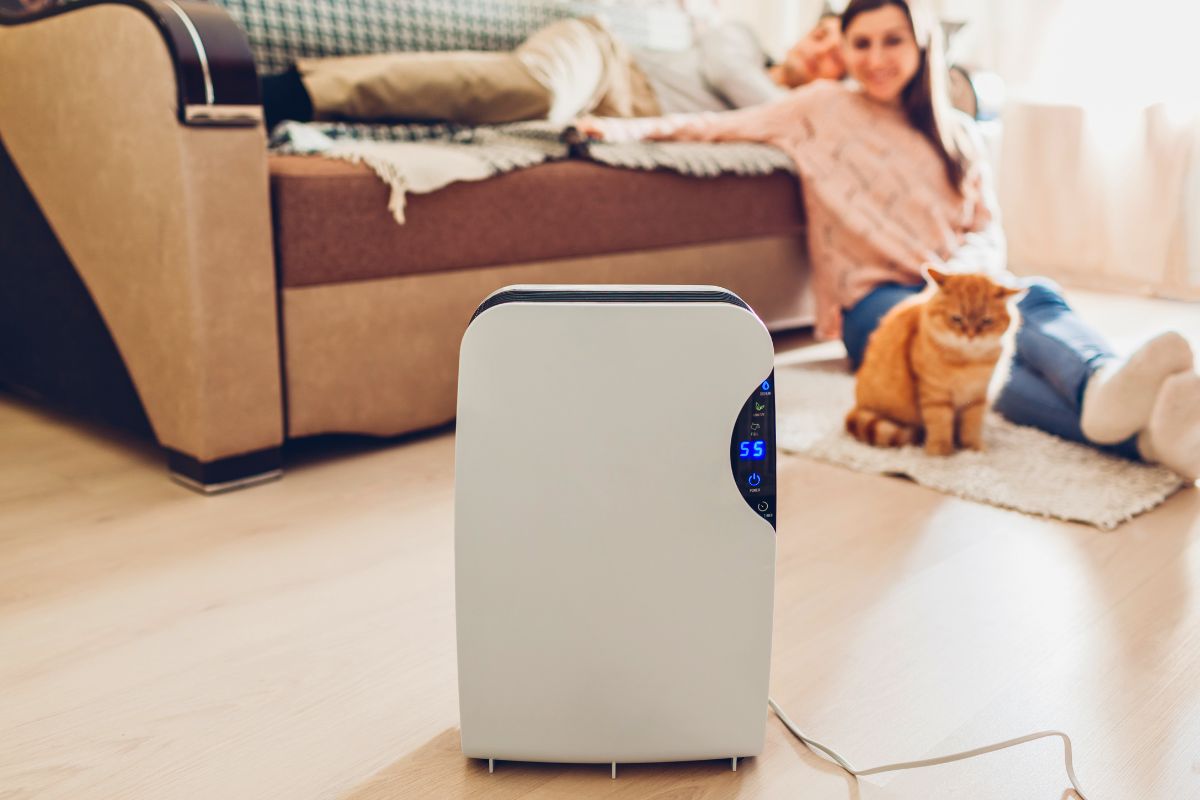
Knowing how to choose a good dehumidifier for home use comes down to three decisions. Match the type to how warm the room stays, size it by litres of water removed per day, and insist on a humidistat. Compressors suit heated rooms, desiccants suit cold ones, and most homes remove between 10 and 20 litres a day.
- Compressors work best above 15°C. Desiccants keep going down to 1°C.
- “Size” means litres removed in 24 hours, not the size of the tank.
- A bedroom needs 10–12 L a day. A family house needs 12–20 L.
- Running costs range from under 1p to roughly 16p an hour.
- Fix leaks first. No dehumidifier repairs a wet wall.
Start With The Damp, Not The Machine
Most household dampness is condensation. Moisture from showers, cooking and indoor washing settles on cold glass, cold corners and the wall behind the wardrobe. Warming those cold surfaces, for example with thermal paint, can also reduce how much moisture condenses on them. B&Q’s buying guide notes that over a pint of water is produced by each person daily, simply by breathing.
Rain through a wall, a leaking pipe or a failed damp-proof course is a different problem. If one patch keeps returning in the same spot, use a damp meter or call a surveyor. Poorly insulated walls also stay cold enough for moisture to condense, so reviewing mineral wool insulation options can tackle the cause rather than the symptom. A dehumidifier manages symptoms, not building faults.
Take a reading: a digital hygrometer costs under £10. Breathing Space puts the comfortable band for a UK home at 45 to 55%, and you should not push below 40% in an occupied room. Westmorland and Furness Council advises that indoor humidity should average between 40% and 65%, and notes that mould spores multiply at 70% to 80%.
ALSO READ: How to Get Rid of Clothes Moths Effectively – A Complete Guide
Compressor, Desiccant Or Peltier?
Compressor units pull air over chilled coils, condense the moisture into a tank and blow drier air back out. Ideal Home explains that most will run above 5°C, but they are happiest nearer 20°C. They are the default for heated rooms. If you are still deciding how to warm the room, it is worth checking how much underfloor heating costs, since steady warmth keeps a compressor working efficiently.
Desiccant units absorb water into a rotating wheel of material such as zeolite, then heat the wheel to release it. They work from about 1°C, run quieter and give off warm air. The trade-off is electricity, and many have no humidistat.
Peltier minis use a cold plate instead of a compressor. Very cheap and very quiet, but only 250 to 500 ml a day. Think wardrobes, cupboards and caravans.
| Room temperature | What to buy |
15–30°C | Compressor — ideal |
10–15°C | Compressor — reduced output |
5–10°C | Desiccant |
Below 5°C | Desiccant only |
A heated flat with foggy windows wants a compressor. In a 5°C garage, an 8–10 litre desiccant will beat a far bigger compressor.
What Dehumidifier Size Do You Need?
Capacity is measured in litres extracted over 24 hours. It is not the tank. A 20L model may hold only 4 to 6 litres.
Joshua Warren, dehumidifier expert at AO.com, suggests, ‘Measure the room and opt for smaller or larger appliances depending on their size. For instance, if your room is medium to large in radius (20-50 m²), choose a medium-capacity appliance which will be between 10 and 20 litres a day.’
| Your situation | Starting point |
Small bedroom, mild condensation | 10–12 L |
Bathroom or one damp room | 12 L |
Two to three bedrooms | 15 L |
Three to four bedrooms | 18 L |
Large home, heavy laundry, bad damp | 21 L+ |
Cold garage, cellar or caravan | Desiccant, 8–12 L |
VonHaus makes the valid point that floor area alone is not sufficient. A small, very wet bathroom can need more help than a large airy bedroom. If the damp mostly comes from showering, small shower room ideas that improve ventilation will take some pressure off the machine.
Those headline ratings are measured at 30°C and 80% humidity, conditions a British home never sees. Allergy Best Buys argues the real daily requirement runs from about 1 litre for one person to 2.5 litres in a house of five or more.
A larger unit reaches your target faster and then rests. A small one runs flat out and never catches up. When in doubt, go one size up.
Dehumidifier Running Costs
Ofgem’s price cap for 1 October to 31 December 2026 sets electricity at an average 26.32p per kWh. Pro Breeze puts a 160W 10L compressor at about 4.2p an hour, a 200W 12L model at 5.3p, a 330W 20L unit at 8.7p and a 620W desiccant at 16.3p. A 23W mini costs roughly 0.6p.
Compressors are cheaper to run than their reputation suggests. Desiccants cost more because they heat their wheel. Compare litres removed per kWh, not watts.
Features That Earn Their Keep
A humidistat is the one to insist on. Set your target and the unit cycles itself on and off, so it is not running when the air is already dry. If you want remote control as well, smart home devices such as app-connected plugs can add scheduling, though they are no substitute for a built-in humidistat.
Laundry mode runs the fan harder until the washing is dry or the timer ends. Continuous drainage sends water straight to a drain, ideal in cellars. Auto shut-off stops overflows. Defrost protects the coils in cooler rooms. Over 8 litres, wheels and a handle stop being a luxury.
Noise is the complaint owners raise most. Aosom UK lists its 12L HOMCOM unit at 38dB, dropping to 35dB in sleep mode.
As Chris Michael, Managing Director of Meaco, explains, ‘One of the main problems with many dehumidifier units is that they are noisy at night when you want to sleep. Look for dehumidifiers that have won the Quiet Mark award for low noise. These dehumidifiers typically have a night or quiet mode, where the fan operates at its lowest speed, so even if your unit is removing water from the air overnight, it shouldn’t disturb you.’
Placing It And Looking After It
Stand it centrally or on a landing to treat a whole floor. Leave 15 cm clear on every side and keep doors and windows shut. Vacuum first so dust does not clog the filter.
Drying out a damp room the first time takes 8 hours to several days. After that, 2 to 4 hours a day usually holds the level.
Electrical Safety First advises keeping it away from walls, furniture and curtains, plugging it into a wall socket rather than an extension lead, and not running it overnight or while you are out unless the manufacturer says unattended use is safe.
Empty the tank after use, wash it fortnightly and clean the filter regularly. Check for UKCA or CE marking, and check any second-hand unit against recall notices.
ALSO READ: Luxury Modular Houses: Redefining Modern British Architecture
Final Verdict: How To Choose A Good Dehumidifier For Home
Buy for the coldest the room gets, size up rather than down, and pay for a humidistat before you pay for an app. Get those three right and the windows stay clear all winter.
FAQs
Q1. What Size Dehumidifier Do I Need For A 3-Bedroom House?
Around 15 to 18 litres a day is suitable for most three-bedroom homes. Go to 20L or more if you dry wash indoors often or several rooms smell musty.
Q2. Is A Compressor Or Desiccant Dehumidifier Better For A UK Home?
A compressor is better for heated rooms, which covers most of the house. Choose a desiccant only for garages, cellars and unheated spaces below 15°C.
Q3. How Much Does It Cost To Run A Dehumidifier?
Roughly 4p to 9p an hour for a typical home compressor at current rates. Desiccants cost more, near 16p an hour, because they use a heater.
Q4. Can A Dehumidifier Dry Clothes?
Yes. It removes the moisture the washing releases, so clothes dry faster in a closed room. Laundry mode and strong airflow make a clear difference.
Q5. What Humidity Should I Set My Dehumidifier To?
Aim for 45 to 55% in a UK home, and no lower than 40%. Mould risk rises once readings sit above 65%.
Q6. Will A Dehumidifier Stop Condensation On Windows?
It cuts condensation a lot by removing moisture before it settles on cold glass. It may not clear it completely in a very cold or poorly ventilated room.
Disclaimer: This article is provided for informational purposes only and is not intended as a promotion or endorsement of any product, brand, or service. Home conditions, energy rates, and appliance needs can vary, so readers should verify facts independently and consult a qualified professional before making purchasing or property decisions.