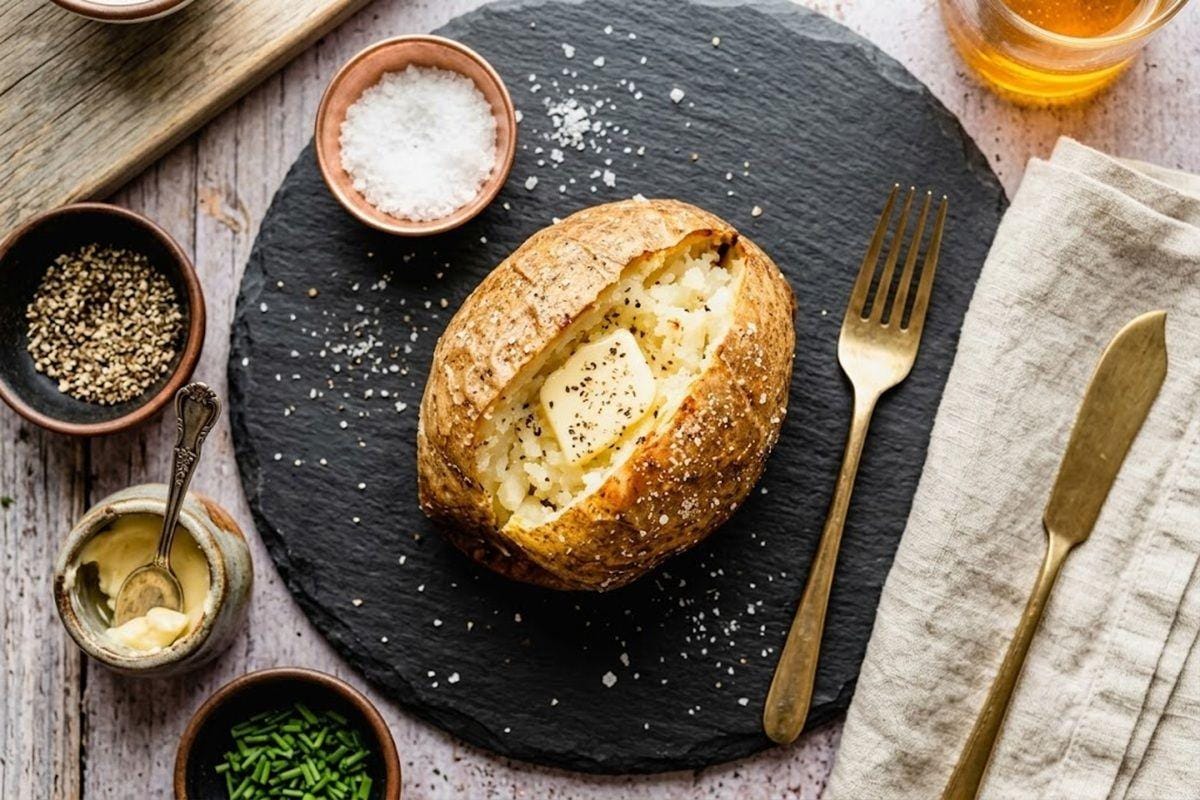
If you’re wondering how to cook a jacket potato properly, here’s the answer: scrub a floury potato like Maris Piper, prick the skin a few times, rub with oil and salt, bake at 200°C (180°C fan) for 60–90 minutes until the skin’s crisp and a knife slides with no resistance.
It sounds simple. It is simple. But there’s a fair bit of bad advice floating around — foil-wrapping, microwave shortcuts that leave a soggy middle, ovens set too low. Get a few basics right, and you’ll have a proper jacket potato every time.
- Choose a floury variety — Maris Piper, King Edward or Rooster work best
- Never wrap the potato in foil if you want crispy skin
- A medium potato takes 60–90 minutes at 200°C (180°C fan)
- Microwave-then-oven is the fastest route to a genuinely good result
- A plain medium jacket potato is roughly 150–180 calories before toppings
Picking The Right Potato
Not every potato is built for baking. You want a floury type with a high starch content — that’s what gives you the fluffy, almost powdery inside once it’s cooked. Waxy potatoes (like Charlotte or Jersey Royals) hold their shape too well and turn dense rather than light.
In UK supermarkets, look for potatoes labelled “baking potatoes” — usually Maris Piper, King Edward, or Rooster. Size matters too. A medium spud, around 200–250g, cooks evenly. Anything much bigger and you risk a cooked-through skin with a still-firm centre.
The Oven Method (The Proper Way)
This is the classic technique, and honestly, it’s still the best if you’ve got the time.
- Preheat your oven to 200°C (180°C fan / gas mark 6).
- Scrub the potato under cold water — don’t peel it, the skin is where a lot of the flavour and fibre lives.
- Dry it thoroughly. Wet skin steams rather than crisps.
- Prick it several times with a fork. This stops it splitting open in the oven as steam builds up inside.
- Rub with a little oil and a good pinch of salt. This is what gives you that crackly skin.
- Bake directly on the oven shelf, not on a tray, so hot air circulates around the whole potato. Pop a tray underneath to catch any drips.
- Bake for 60–90 minutes, depending on size. It’s done when the skin looks shrivelled and golden, and a skewer or knife goes in without a fight.
Skip the foil. Wrapping a potato traps steam next to the skin, which is exactly what you don’t want — you’ll end up with something closer to a boiled potato in a jacket.
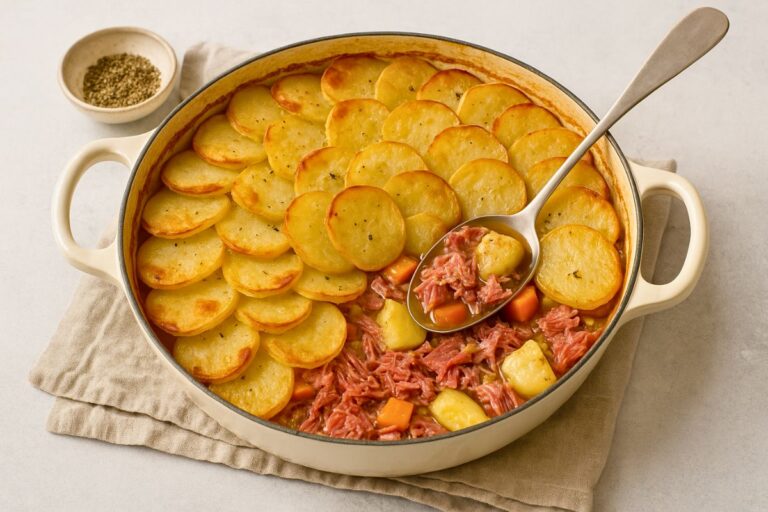
ALSO READ: The Art of Cooking The Perfect Corned Beef Hotpot That Never Lets You Down
Faster Methods That Still Work
Not everyone has 90 minutes spare on a Tuesday night. Here’s how the alternatives stack up.
| Method | Temperature | Typical Time | Result |
| Conventional Oven | 200°C (180°C fan) | 60–90 min | Crispiest skin, best flavour |
| Microwave Only | High (800W) | 8–12 min | Fast but soft, pale skin |
| Microwave Then Oven | Microwave 5–7 min, then oven 20–25 min | ~30 min total | Nearly as good as oven-only, much quicker |
| Air Fryer | 200°C | 40–50 min | Very crisp skin, slightly drier centre |
Source: Cooking guidance collated from BBC Good Food and NHS recipe resources; timings will vary by potato size and appliance.
The combination method is genuinely underrated. Microwave the potato for 5–7 minutes to get the middle cooking through, then finish it in a hot oven for 20–25 minutes to crisp the skin. You get most of the flavour of a fully oven-baked potato without the wait.
Air fryers have become a popular shortcut in UK kitchens too, largely thanks to rising energy costs making the big oven feel like overkill for one potato. Prick it, oil it, salt it, and cook at 200°C — checking from the 35-minute mark onwards since air fryer models vary quite a bit.
How To Tell Jacket Potatoes Are Actually Done
Time is a guide, not a guarantee. Ovens differ, and potato sizes vary more than people think. Instead of just watching the clock:
- Squeeze test (with oven gloves): it should give slightly under gentle pressure.
- Skewer test: push a skewer or knife through the centre — it should meet no resistance.
- Look at the skin: properly done, it’s shrunken, wrinkled and deep golden, not tight and pale.
If in doubt, give it another 10 minutes. An undercooked jacket potato is far more disappointing than one that’s spent a bit longer in the oven.
Toppings That Actually Work
A jacket potato is really a vehicle. Classic British choices include:
- Butter, salt and black pepper — the original, and still hard to beat
- Baked beans and grated cheese — a classic, though many Britons are now exploring Turkish eggs to elevate their meal options
- Tuna mayo with sweetcorn
- Chilli con carne
- Cottage cheese with spring onion, for a lighter option
For a healthier plate, swap butter for a spoon of Greek yoghurt and pile on vegetables or beans rather than cheese. A tuna and bean jacket potato, for instance, comes in at around 281 calories per serving with 20g of protein and 8g of fibre when made with lean toppings — proof that a jacket potato doesn’t have to be a calorie bomb.
On its own, plain and unadorned, a medium jacket potato sits somewhere around 150–180 calories, with a decent hit of potassium, vitamin C and fibre — most of which is concentrated in that skin you’re eating rather than peeling off.
Common Mistakes Worth Avoiding
A few things trip people up again and again:
- Wrapping in foil. As mentioned, this steams the skin rather than crisping it.
- Skipping the prick. Steam has to escape somewhere — better through small fork holes than a split down the side.
- Cooking on a tray. Air can’t circulate underneath, so the base goes soft and pale.
- Rushing the microwave-only method. It’s fine in a pinch, but the skin never gets that proper bite.
- Not drying the potato before oiling it. Water and oil don’t mix, and a damp skin won’t crisp properly.
ALSO READ: Bran Flakes: Are They Really Good for You? Nutrition, Benefits And Gluten Facts
FAQs
Q1. How Long Does A Jacket Potato Take In The Oven?
Around 60–90 minutes at 200°C (180°C fan), depending on the size of the potato.
Q2. What’s The Best Potato For A Jacket Potato?
A floury variety — Maris Piper, King Edward or Rooster are the usual choices in the UK.
Q3. Should You Wrap A Jacket Potato In Foil?
No. Foil traps steam and softens the skin instead of letting it crisp up.
Q4. How To Cook A Jacket Potato In The Microwave?
Yes, in 8–12 minutes on high, though the skin stays soft. Finishing it in the oven afterwards gives a much better result.
Q5. How Many Calories Are In A Plain Jacket Potato?
Roughly 150–180 calories for a medium potato before any toppings are added.
Sources & References
BBC Good Food. How to make the ultimate baked potato.
National Health Service. Tuna and bean jacket potatoes recipe. Healthier Families.
Public Health England. McCance and Widdowson’s composition of foods integrated dataset (CoFID). GOV.UK.
Disclaimer: This article is provided for general informational and educational purposes only and is not intended as promotional material, professional culinary advice, or nutritional guidance. Cooking times, nutritional values, and preparation techniques may vary depending on individual appliances, ingredient sizes, and dietary needs. Readers should verify facts independently and seek professional advice or guidance before making culinary, health, or dietary decisions based on this content.