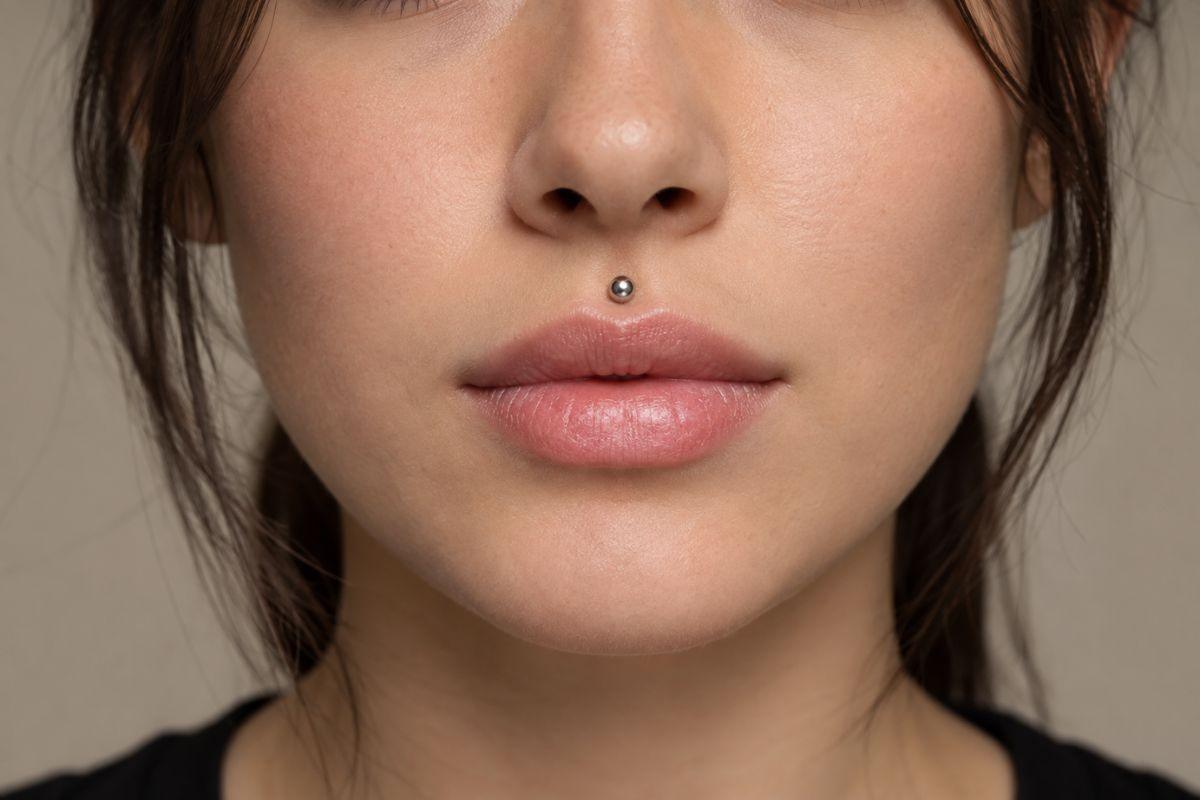
A Medusa piercing is a lip piercing positioned centrally in the philtrum, the small dip directly above your Cupid’s bow. Before getting a Medusa piercing, you should know essential details about its placement, pain, costs, healing timeline, and potential oral risks.
Typically fitted with a flat-back labret stud, the procedure rates around 4 to 6 out of 10 on the pain scale. In the UK, it costs roughly £20 to £65, requiring 6 to 12 weeks for initial swelling to settle.
- Piercers call it a philtrum piercing. Medusa is the nickname.
- Pain is real but over in seconds, usually 4 to 6 out of 10.
- Outside swelling settles in 6 to 12 weeks. Heals fully in 3 to 4 months.
- You start with a long 14g or 16g titanium labret stud.
- Downsize at 2 to 4 weeks, or your teeth pay for it.
What Is A Medusa Piercing?
The needle goes through the philtrum, above your Cupid’s bow, and out inside your mouth. It’s a lip and oral piercing at once, so it needs more babysitting than an earlobe. Healthline explains the area is stuffed with nerve endings, so it smarts.
Not everyone can have one. Urban Body Jewelry warns that thick frenulum webbing or a snaggle tooth can block placement. The bar must sit perpendicular to your lip too, or it’ll fight you.
ALSO READ: Deep Tissue Massage: Everything You Need To Know About
Why Is It Called A Medusa?
In the 1990s, it was an upper labret piercing, until a Canadian piercer decided “philtrum” was too dull. Some link it to the Greek gorgon, whom the Metropolitan Museum of Art calls a symbol used to ward off evil. Google Trends shows it peaked in 2022.
The Three Types
| Type | Where it comes out | Jewellery |
Standard medusa | Inside your mouth | Labret stud |
Vertical medusa (jestrum) | Under your top lip | Curved barbell |
Double philtrum | Two studs, stacked | Two labret studs |
Source: Data compiled from Association of Professional Piercers (APP) standard guidelines.
The jestrum suits anyone worried about their teeth: nothing rests on your gums, and it can’t spin.
Does It Hurt?
Yes, and your eyes will probably water. Lips are a tactile sensory organ packed with nerves and blood vessels, so there’s no dodging it. Clinical research published in MDPI’s Applied Sciences notes that post-operative swelling occurs in 24% to 98% of oral piercing cases, while localized pain or tenderness affects between 14% and 71% of individuals during initial healing. The sharp bit lasts a second, then a dull throb for a few days.
The Process, Step By Step
- You talk through healing, risks, allergies and medication, then sign a waiver.
- Your piercer marks the spot, centred outside and lined up inside.
- Skin gets a surgical scrub, and you rinse with alcohol-free mouthwash.
- Forceps pull the tissue clear of your teeth.
- The needle goes outside in, with a taper pin behind it.
- The labret is threaded in, the top fixed on, then saline stops the bleeding.
You leave with written aftercare. Needles only, never a gun, and tools should be in sealed pouches in front of you.
Healing Timeline
| Stage | When |
Worst of the swelling | Days 3 to 5 |
Swap the long bar for a shorter one | Weeks 2 to 4 |
Outside feels normal | 6 to 12 weeks |
Actually healed inside | 3 to 4 months |
Source: Association of Professional Piercers (APP) Aftercare & Healing Standards
Byrdie makes a fair point: your medusa piercing moves every time you talk or eat, which slows down healing. It heals from the outside in, so it can look grand while the inside is raw. Calming scents in the evening can help you relax through the slower stretches of healing.
For three to five days, expect swelling, bruising, tenderness, a little blood and white or yellow crust on the jewellery. A white ring of tissue can appear, and yellowish strings inside look grim but are normal. The swelling is proper swelling, like cheap lip fillers.
Aftercare That Works
The Association of Professional Piercers keeps it simple:
- Wash your hands first. Every time.
- Sterile saline spray outside twice daily, then pat dry with gauze.
- Alcohol-free, peroxide-free mouthwash after meals, plus a water rinse after eating or smoking.
- Brand-new soft toothbrush, and keep flossing.
- Sleep propped up. Ice and cold food bring swelling down.
- Take ibuprofen or naproxen sodium for pain, and check that the threaded ends stay tight with no gap in the push-fit tops. A soothing home spa session can also help you relax while your body copes with the discomfort.
Never mix your own salt water at home. It isn’t the same thing, and it’ll set you back.
Skip while healing: twisting the jewellery, gum, biting nails, sharing cups, straws, kissing, alcohol, smoking, pools and baths.
Give spicy, salty, acidic and hot food a fortnight off, and keep make-up and whitening products away. Eat slowly, and drink plenty of water, since saliva helps oral wounds heal.
Jewellery And Gauge
You start with a flat-back labret stud, internally threaded or threadless, at 14 or 16 gauge, deliberately long to allow for swelling.
Stick to implant-grade ASTM F-136 titanium, 14 ct to 18 ct nickel-free gold, niobium, surgical steel, platinum or glass. Nickel is the most common allergen. Once healed, swap tops for whatever you fancy.
ALSO READ: Classic to Contemporary: Beauty of East-West Engagement Rings
Piercing Cost In The UK
Studios like Underground Tattoos in Watford charge roughly £20 to £40 for the piercing, and roughly £65 is about the national ceiling. Jewellery is separate: from £15-ish for titanium, into three figures for gold. Check that your studio is council-registered. That’s the law here.
Changing And Downsizing
Once the swelling drops, book the downsize. A long bar rattling against enamel and gums does real damage, so let your piercer do it the first time.
After that: wash up, wear gloves for grip, lubricate the piercing, and never force it in. If it won’t go, ring the studio. Left empty, the hole can close within hours.
Risks Worth Knowing
Research suggests up to half of people with oral piercings were never told the risks.
Lip piercings are linked to tooth injuries in up to 26% of wearers and gum recession in up to 50%, over four times likelier than in people without one. Neither grows back. Add rejection, irritation bumps, metal allergies, endocarditis, blocked dental X-rays, and hepatitis or HIV from a dirty kit.
Cleveland Clinic says to see someone if it stays swollen, hot, red and painful. Best Life flags the same, and any two of these need a GP: redness, shooting pain, discolouration, pus or fever. If your gums turn sensitive, downsize or take them out. Scarring is permanent, so think it through.
ALSO READ: What Does Hyaluronic Acid Body Wash Do Actually? Explained Simply
FAQs
Q1. Is A Medusa Piercing Safe?
Yes, with a council-registered piercer, a needle and implant-grade jewellery. Gum recession and tooth damage are the real long-term worries.
Q2. How Painful Is A Medusa Piercing Out Of 10?
Around 4 to 6 for most people. Sharp for a second, then a dull ache for days.
Q3. Can I Get A Medusa Piercing At 16 In The UK?
Some pierce from 16 with a parent present; others wait until 18. Ring ahead and ask.
Q4. Can I Wear Lipstick With A Medusa Piercing?
Not while healing. Once settled at three to four months, lipstick and balm are fine.
Q5. Will A Medusa Piercing Damage My Teeth?
It can if the bar is too long or badly placed. Downsizing on time reduces most of the risk.
Q6. Does A Medusa Piercing Leave A Scar?
Usually a small permanent mark. Good aftercare keeps it tiny, but laser or surgery is the only real fix.
Sources & References
- Healthline. (2026). Medusa piercing: Risks, pain, and aftercare.
- Best Life. (2026). Medusa piercing: Signs of infection and when to see a doctor.
- Byrdie. (2026). Medusa piercings guide: Healing, placement, and care.
- Urban Body Jewelry. (2026). Philtrum piercing information and aftercare.
- Metropolitan Museum of Art. (2026). Medusa in Greek art: Symbolism and cultural meaning.
Disclaimer: This article is provided for informational and educational purposes only and is not intended for promotional purposes. The medical and bodily care information contained herein should not be used as a substitute for professional health advice. Readers are strongly advised to independently verify all facts and consult a qualified medical professional or certified piercer before undergoing any body modification procedure.