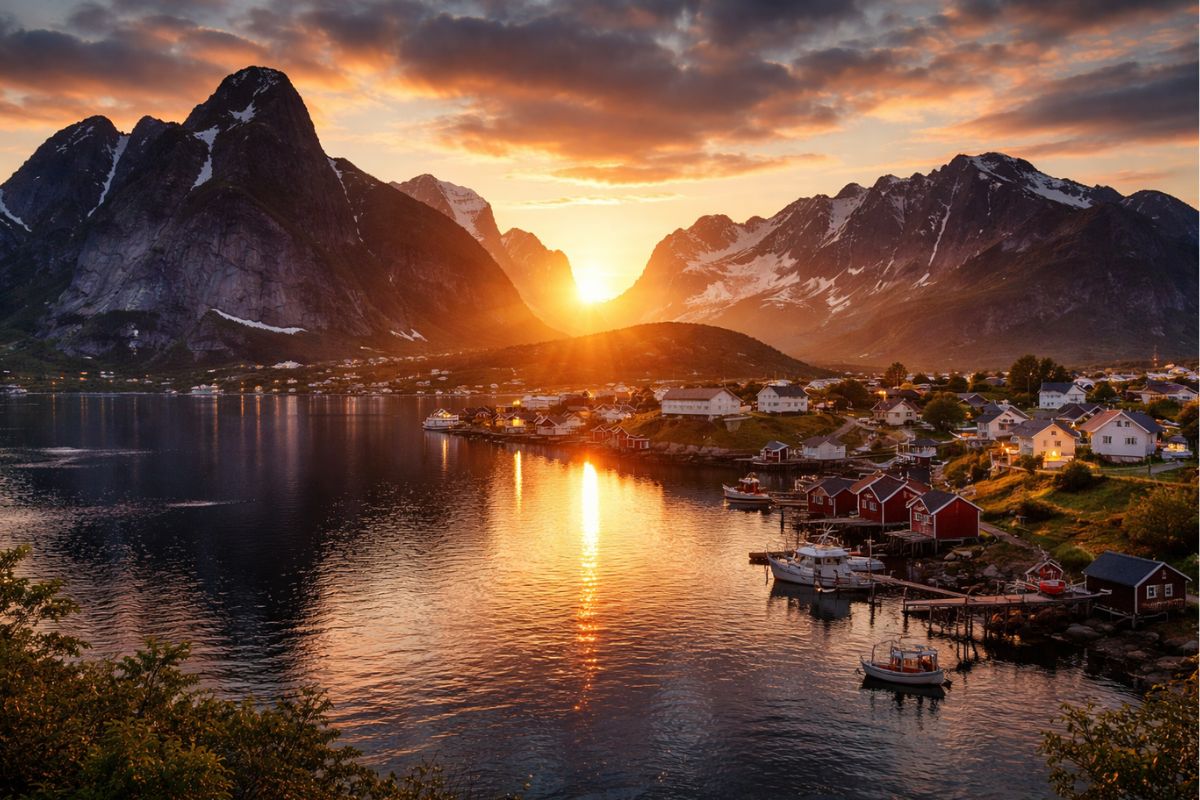
The relentless sun of Southern Europe has lost its charm for many British travellers. After the record-breaking heatwaves of recent years, the idea of sweating through a Roman afternoon or tussling for a square inch of sand in Marbs is losing its charm. In its place, a new trend known as “coolcation” has emerged for the year 2026 like Norway midnight sun summer. People are choosing to swap the blistering heat for the icy, golden clarity of the Arctic Circle. But the best part is you’re not sacrificing that sunshine. You just take it at 3:00 A.M., while standing on a craggy mountain peak.
In the depths of Northern Norway, there is no such thing as “night” during the summer. This does not imply that there are only long days; rather, it refers to a 24-hour cycle in which the sun never sets. It is a one-of-a-kind experience that feels surreal and absolutely hallucinogenic at times when your internal watch goes right out the window.
If you have never stood on a beach in Lofoten at midnight to see the water turn a bruised purple while the sun glows like a low-hanging amber lamp—well, you’re missing out on one of nature’s strangest and most beautiful glitches.
The 2026 Travel Shift: Slowing Down In The North
This year, the buzz isn’t just about the sight but about how we’re experiencing it. Norway is embracing “slow travel” in a big way for the Norway Midnight Sun Summer season. The greatest news of June 2026 is that the SKREI Museum opens in Storvågan! This place is going to be the cultural heartbeat of the Lofoten Islands, pulsing with a thousand-year backstory about how cod fishing built this part of the world. But the museum is not some dust-choked building on a wind-swept plain; it’s an enormous architectural statement that fits the rugged terrain like a glove.
And then there is Ytri Island Retreat on Træna, which opened in April 2026. If you need to watch the sun sink into the ocean from a luxury sauna on your own private island, here it is. It’s trending as one of the most unique places to stay in all of Europe. The move to these high-end, eco-minded retreats is another sign that travellers want depth—and not just a tan.
Timing Your Arctic Escape: The 2026 Calendar
You can’t just roll up in August and expect an entire 24-hour glow. The window for the Norway Midnight Sun Summer differs depending on how far you are willing to wander toward the North Pole. Here’s the lowdown on where to be and when for 2026:
| Destination | 2026 Midnight Sun Dates | Why It’s Special |
|---|---|---|
| Svalbard | 20 April – 22 August | Four months of solid sun. Total madness. |
| North Cape | 14 May – 29 July | The literal edge of the European continent. |
| Tromsø | 20 May – 25 July | The “Paris of the North”—amazing food and vibes. |
| Lofoten Islands | 28 May – 14 July | Most photogenic peaks and white sand beaches. |
| Bodø | 4 June – 11 July | A major 2026 hub with easy access to the islands. |
Look, if you want the most intense experience, Svalbard is the winner. The sun stays up for four months straight. But for most of us, Tromsø or Lofoten hits the sweet spot of accessibility and mind-blowing views.
The New “Silent” Frontier
Norway is in the vanguard of Zero-Emission Fjords. And by this summer, electric ferries and “silent” fjord cruises will have proliferated. Try drifting through a small fjord at 1 am on a RIB boat. Ordinarily, you would have the deafening roar of a diesel engine. Now? It is nothing but the sound of the water against the hull and the distant cry of a sea eagle.
These new electric tours are a game changer for wildlife spotting. You can get shockingly close to seals and whales because they don’t hear you coming from a mile away. It’s a lot more respectful way to see the Arctic, and, honestly, it makes the whole experience way more personal.
Hiking At 2:00 AM (Because Why Not?)
The odd thing about taking a Norway Midnight Sun Summer trip is the super strength. Your body forgets to be tired when the sun doesn’t set. Simply take a hike up the Lofoten’s Reinebringen, and you’ll find groups of hikers beginning their ascent at midnight.
The light of that time of day is something. It’s not the harsh midday glare, but a warm, diffused gold that makes the mountains appear to glow from within. My advice? Don’t bother playing 9-to-5 catch-up; it’s not going to work here. Eat dinner at midnight. Go for a swim at 3:00 AM. Sleep when you’re flying home.
ALSO READ: Life in the Dark: What It’s Like Living Where the Sun Never Rises
The “Coolcation” Road Trip: Kystriksveien
And if you do not want to be a part of huge cruise ship crowds, Norway’s Kystriksveien Coastal Route (Helgeland) is the new hot drive for 2026. This route takes you directly through the Arctic Circle. It’s a slower, more organic burn than the standard tourist path. You’ll stumble on minuscule fishing villages, secluded beaches, and plenty of space to breathe.
British travellers are “micro-dosing” their holidays this year, too. Groups are opting to do high-intensity, four-day hops to Tromsø rather than one long, draggy fortnight. There’s time for lounging around in the sun, a midnight hike and returning to the UK before the lack of darkness starts making you see things.
Pro Tips For The Arctic Rookie
- The Eye Mask Is Essential: Do not try to be a hero. Most hotels offer blackout curtains, but the sun never sets this time of year in the Arctic. It finds every gap. Pack a real (or at least higher quality than the one you’ve used like 23 times on red-eyes) eye mask, or else you’ll be wide awake at 4:00 AM wondering why your life suddenly feels like a horrible dream.
- Book Now (Seriously): Record bookings for July 2026 are already happening. Those famous red fishing cabins (Rorbu) in Hamnøy often disappear six months to a year in advance.
- Layer Up: It may be sunny, in the sense that you can see the sky and birds flying around, but it’s not tropical. It could be 15°C at midday and 5°C while you are out on the water or on a mountain peak.
Why This Matters Now
And the shift to the north—it isn’t just about escaping heat; it’s about a longing for something raw and real. This influx of “coolcationers” has changed the way these Arctic towns function, focusing even more on sustainability and local culture than in previous years, says the Visit Norway 2026 Guide.
Anyway, there’s something wonderfully humbling about standing on the North Cape, gazing out over the barren Barents Sea, and realising that you’re looking at the sun going nowhere. It helps keep life’s daily anxieties in check. The world is massive, strange and blinding. Who wants to sweat out the summer waiting in a queue when you could be basking in 24-hour gold?
ALSO READ: Ten Cracking Spots You’ve Got to See in London
FAQs: Everything You Need To Know
Q1. Does The Midnight Sun Actually Look Like Daytime?
Not exactly. It’s more like a permanent sunset or sunrise. You will find the shadows to be long, the light warm and golden, and the sky has a way of taking on pinks and oranges that seem to linger for hours. It’s softer by far than the harsh light that you get at noon.
Q2. Can I See The Northern Lights In The Summer?
Nope. To view the Aurora, you need a dark sky. Because the sun is up 24 hours a day during the Norway Midnight Sun Summer, it never gets dark enough for the lights to be seen. If you want the lights, return in October.
Q3. Is It Expensive To Visit Northern Norway In 2026?
Norway is not the most budget-friendly of destinations, let’s be real. The spread of “micro-dosing” trips and improved flight connections from the UK have helped. The best way to prevent costs from mounting is to pre-book your car rental, or even better, accommodation.
Q4. Is It Safe To Hike At Night?
In terms of the visibility, yes—it’s bright out! However, the terrain remains rugged, and the weather can quickly change. Keep abreast of local forecasts and let someone know your intended route, even if it feels like broad daylight.
Q5. What Is The “Lipstick Effect” In Travel?
It’s a 2026 trend: spending on smaller but high-quality experiences (like this 4-day Arctic trip), rather than one big bank-breaking holiday. It’s all about getting the most value for your money.
Sources & Travel Resources
- Norwegian Maritime Authority. (2025, April 15). Zero-emission requirements for the World Heritage fjords adopted.
- Visit Norway. (2025, March). News and updates on travel experiences in Norway.
- Museum Nord. (2025). SKREI – The fish that built Norway.
- The Opening List. (2025). Ytri Island Retreat – Hotel opening details.
- Gössling, S. (2024). Rising global temperatures and tourism: Decoding the ‘coolcation’ trend in Nordic destinations. ResearchGate.
Disclaimer: This article is provided for informational and editorial purposes only. It does not constitute travel advice, endorsement, or promotion of any destinations, services, organisations, or businesses mentioned. Readers are encouraged to conduct their own research and verify details independently before making travel or purchasing decisions.
Recommended