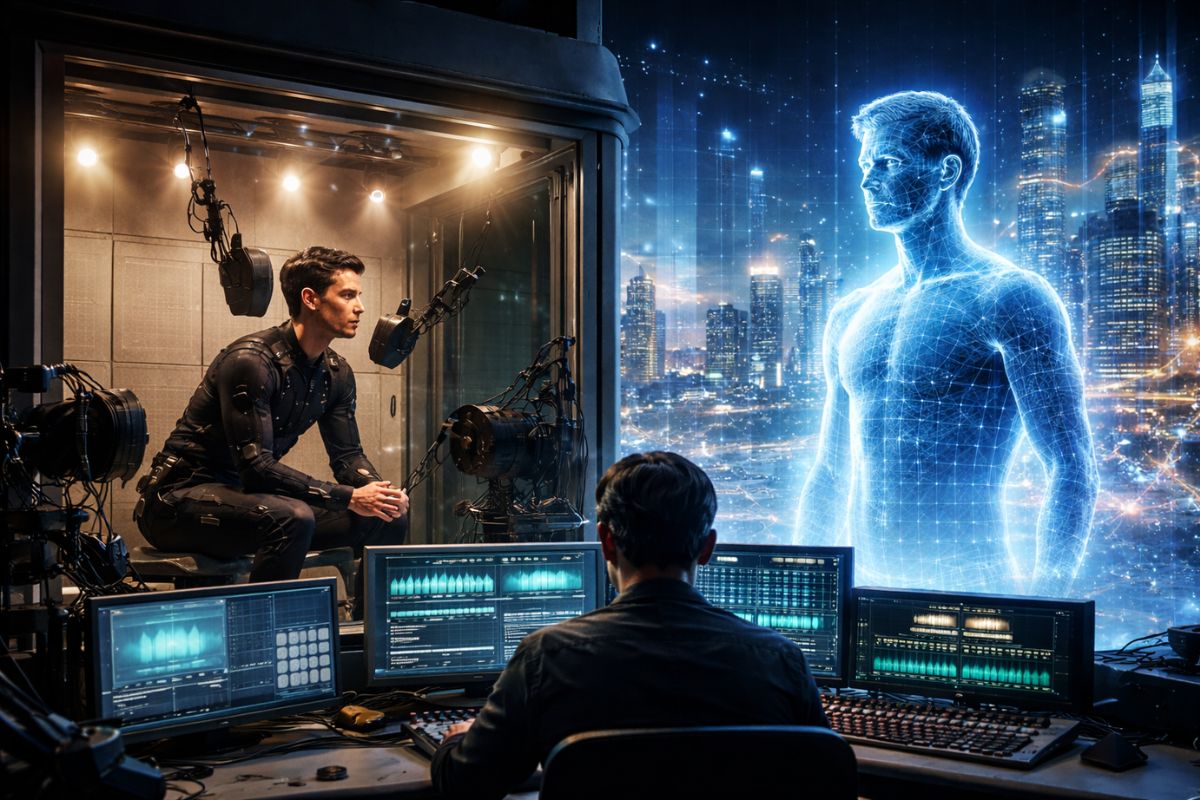
Imagine walking onto a film set in Pinewood Studios, but instead of the usual chaos of cables and coffee runs, it’s eerily quiet. A famous lead actor isn’t there in the flesh. Instead, their digital ghost is doing the heavy lifting. This isn’t some far-off sci-fi plot anymore. By March 2026, the Digital Twin has moved from being a techy buzzword to a living, breathing legal entity that’s currently upending how we think about work, identity, and the very soul of performance.
For years, we thought of these things as just 3D models of engines or smart buildings. Useful? Yeah. Beautiful? Not really. But the shift over the last twelve months has been dramatic. We’ve moved past simple visualisations.
Today, the UK is treating these virtual replicas as an operational layer for everything from managing the National Grid to keeping hospitals running. But the real drama isn’t happening in a server room in Slough. It’s happening in the courtroom and the recording booth.
The stakes have never been higher. We’re currently seeing a massive tug-of-war over who actually owns “you” when you’re rendered in ones and zeros. It’s a bit of a mad situation. Actors are now fighting for what legal experts call Data Dominion—the idea that your digital duplicate is an extension of your physical body, not just a file owned by a studio.
If you think your job is safe from a digital takeover, you might want to look at how the entertainment industry is drawing up the blueprints for the future of work.
The New Gold Rush In Voice Licensing
Last month, at CES 2026, the world got a proper look at how the game has changed. We saw the unveiling of the ‘Digital Twin’ Contract: How Actors Are Licensing Their AI Voices In 2026. This isn’t your standard boilerplate contract. It’s a highly specific, high-stakes agreement that treats a person’s voice like a precious commodity.
Gone are the days when a studio could just record a few hours of audio and use it however they liked. Now, thanks to the latest SAG-AFTRA Interactive Media Agreement, there’s a clear standard for what they call Vocal Digital Replicas.
Here’s the kicker: actors are now getting paid per “line” generated. And in this world, a line is roughly 10 words. Think about that. Every time an AI version of a famous actor speaks in a video game or an advert, the meter is running.
This change didn’t happen by accident. It’s the result of some seriously hard-nosed bargaining. British actors have been right at the forefront of this. The UK actors’ union, Equity, has been pushing through landmark ballots to ensure that a performer’s likeness or voice can’t be reused without explicit, per-use consent.
It’s all about putting the power back into the hands of the person who actually owns the throat the sounds come from.
ALSO READ: Elsie-Rose Thomas: The Life of English Actor Adam Thomas’ Daughter
Smart Buildings And The Ghost In The Machine
While actors are busy protecting their voices, the rest of the UK is busy building a digital mirror of the entire country. The National Digital Twin Programme is no longer a pilot project; it’s a full-blown reality. We’re talking about massive data standards and governance that allow the government to see how infrastructure is performing in real-time.
Anyway, the real shift in 2026 is that we’ve stopped looking at these as models. As experts noted during the Digital Twin Hub’s Gemini Series, these twins are now the operational layer for society. If a water pipe is about to burst in Manchester, the digital twin likely knew about it three days ago because of a pressure anomaly that no human would have spotted.
In sectors like higher education and healthcare, we’re seeing Smart Building Operations that manage energy usage down to the penny. It’s brilliant for the planet, sure, but it’s also a bit unsettling. Your office building now knows exactly when you arrive, which lift you took, and how much CO2 you’re breathing out. It’s all fed back into the virtual replica to keep things efficient. It’s efficiency at the cost of total surveillance.
The ‘Digital Twin’ Contract: Why It Matters For Everyone
You might think, “Well, I’m not a Hollywood star, so why do I care about The ‘Digital Twin’ Contract: How Actors Are Licensing Their AI Voices In 2026?” Here’s the thing: the legal precedents being set right now are going to affect everyone eventually.
Look at the way entertainment law firms are now using AI-specific addenda. These contracts have to be incredibly specific. They have to define whether an AI twin can be used for real-time generation—like those chatbots that sound a bit too human—or just for pre-recorded content.
There are also strict moral rights clauses. Actors are terrified that their digital clones will be used to say things they’d never agree to in real life. We’re talking about political propaganda or even just foul language. The contracts now include what they call revocation clauses. It’s basically a kill switch. If an actor doesn’t like how their digital twin is behaving, they can pull the plug on the licence. Honestly, it’s the only way to keep the wild west of AI cloning from becoming a total disaster.
De-Risking The Future Of The UK Economy
The UK government is heavily investing in this tech. The techUK Digital Twins Council has just begun its 2026–2028 tenure, focusing on one agenda item at the table: de-risking innovation. They know that if we can create a simulated supply chain crisis before it happens, they will save billions.
But there’s a huge debate simmering beneath the surface over Digital Duplicates and the social contract. Should a company be allowed to have a digital twin of the warehouse worker to find out how they can push them further? Or does that worker own the data produced by their body?
In 2026, we expect to see a demand for a New Social Contract for digital replicas. The premise is that these twins aren’t meant to be abused—they’re supposed to be used for the betterment of people. It sounds lovely on paper. But when there’s this much money on the table, things usually get messy. We’re moving into a world where your most valuable asset might not be your house or your car, but the data that makes up your digital self.
The Reality Of AI Voice Licensing
If you’re an actor in 2026, your agent isn’t just looking for film roles. They’re looking for licensing deals for your vocal digital replica. The process is pretty intense. You spend a few days in a high-tech booth, reading everything from Shakespeare to the back of a shampoo bottle. That data is then used to build your twin.
But the informed consent isn’t just a checkbox anymore. It has to be a clear and conspicuous separate document. You have to know exactly what you’re signing up for. The opt-out is the most debated part of these new contracts. Performers are requesting the ability to revoke their consent from subsequent works long after they’ve accepted the first pay cheque. It’s sort of like being able to un-ring a bell.
The unusual part is that we’re already witnessing AI-integrated decision-making in casting. Some studios are setting up simulations with digital twins of various actors and assessing which one fits the role better even before they’ve officially sent out an audition notice. It’s a bit cold, isn’t it? Taking the gut feeling out of art and replacing it with an algorithm.
ALSO READ: Can a Cold Plunge Really Help You Burn Body Fat? – Explained
Conclusion
So, where does this leave us? We live in a world where the boundary between real life and virtual reality is crumbling to dust before our eyes. If it’s not a digital twin of the UK’s power grid, then it’s a vocal version of a pop star, and the tech is here to stay.
The ‘Digital Twin’ Contract is the first step on a much longer journey. We are making up the rules as we go along. It seems like we’re building the plane while it’s in the air. The upside is huge — better health care, greener cities, more efficient services. However, there is also a significant risk that things could go awry.
In the end, it comes down to trust. Can we trust the people who own the data? Can we trust that our digital selves won’t be used against us? As we head into the rest of 2026, these aren’t just questions for tech enthusiasts or lawyers. They’re questions for all of us. Because sooner or later, everyone is going to have a twin.
Anyway, do you think you’d be happy to let a digital version of yourself go to work while you stayed in bed? Or does the whole thing just feel a bit too “Black Mirror” for comfort?
Frequently Asked Questions
Q1. What Exactly Is A Digital Twin In 2026?
In 2026, it’s more than just a 3D model. It’s a dynamic, real-time virtual replica of a physical object, person, or system that uses live data to simulate behaviour and predict future outcomes. In the UK, it’s used as an operational layer for infrastructure.
Q2. How Does The ‘Digital Twin’ Contract Work For Actors?
It’s a legal agreement where an actor licenses their Vocal Digital Replica. It includes strict clauses on informed consent, how the voice can be used, and a per-line payment structure (roughly every 10 words generated by AI).
Q3. Can An Actor Stop Their AI Voice From Being Used?
Yes. Modern contracts in 2026 include revocation clauses or opt-out rights. This gives performers the ability to withhold consent for future projects if they don’t like how their digital identical twin is being used.
Q4. What Are The Moral Rights In These AI Contracts?
Such clauses protect actors from allowing their digital doubles to be used for sensitive content they have not personally approved, like political advertisements, offensive language, or material that violates their values.
Q5. Is This Technology Being Used In The UK Beyond Entertainment?
Absolutely. The UK’s National Digital Twin Programme applies it for smart building operations, energy management, and urban planning. It reduces the risks of innovation by simulating real-world scenarios in a controlled, virtual environment.
Sources And References
- TechUK. (2026). Announcing the new techUK Digital Twins Council 2026–2028.
- London Tech Week. (2026). Digital twins as the new crystal ball.
- Digital Twin Hub. (2026). Kicking off 2026: Four global perspectives on digital twin progress.
- Holon Law. (2026). Synthetic media, voice cloning, and the new right of publicity risk map for 2026.
- Frankfurt Kurnit Klein & Selz. (2026). Inside the new SAG‑AFTRA interactive media agreement: New standards for AI and digital replicas. FKKS Technology Law.
- Soundverse AI. (2025). Legal precedents in voice cloning cases (2024–2026): How courts shaped AI voice rights.
- Equity UK. (2025). Film & TV performers say they would be prepared to take industrial action over AI in landslide 99% vote.
- TwinView. (2025). What do digital twins hold for 2026? From visualisation to smart building operations. TwinView Insights.
Disclaimer: This article is published for informational and educational purposes only. It is not intended to promote, advertise, or endorse any organisation, product, service, or individual mentioned within the content. Readers should independently verify information and consult appropriate professionals where necessary. The publisher assumes no responsibility for decisions made based on the information provided in this article.
Recommended