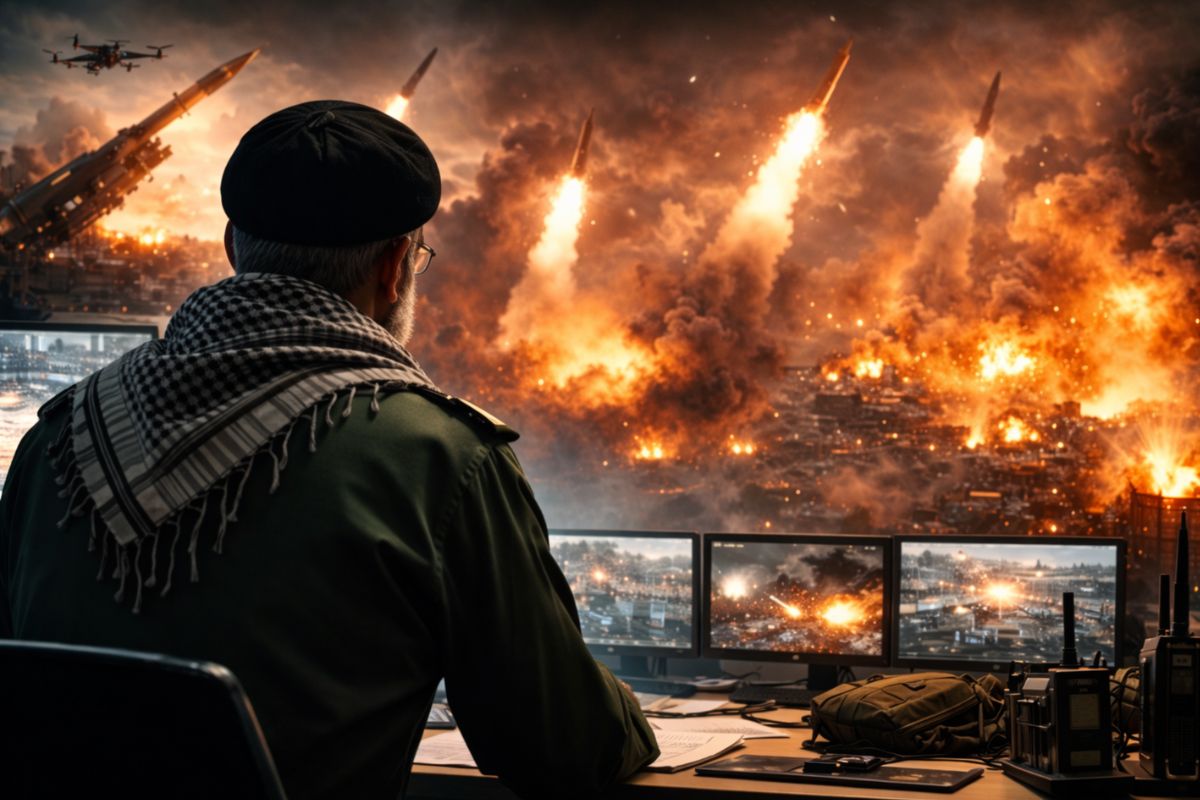
Imagine a glass vase falls on a stone floor. Usually, it will break into useless shards, and the game is over. But what if suddenly each one of those little pieces grew a pair of eyes, picked up a rifle, and started fighting back as if nothing happened? This is the horrifying, brilliant logic behind an idea that is now driving military briefings from Washington to Tehran: mosaic defence.
As of mid-March 2026, the world is watching this theory translate into a brutal reality. With the ongoing “IRAN-US-ISRAEL” War tensions, the old way of fighting—where you cut off the “head” of an army to kill the “body”—is dying. We’ve entered an era of the “Fourth Successor,” where decapitation strikes are no longer the silver bullet they used to be. Whether it’s the high-tech drone swarms envisioned by DARPA or the decentralised provincial commands in the Middle East, the goal is the same: survive by being too fragmented to fail.
What is Mosaic Defence Warfare?
To understand what is mosaic defence warfare, you have to stop thinking about a military as a single, massive machine like a tank or an aircraft carrier. Instead, think of a mosaic. If you remove one tile from a picture, the rest of the image stays perfectly clear.
The concept essentially replaces “monolithic” platforms—billion-pound jets that are too expensive to lose—with thousands of small, cheap, and interconnected pieces. In the US version, developed by DARPA, this looks like a “kill web.” If any one sensor drone gets brought down, the net isn’t plunged into darkness; it just reroutes data through a nearby robot dog or low-orbit satellite. In milliseconds, the system heals itself.
The Iranian version, which Foreign Minister Abbas Araghchi recently bragged about on social media, is much more a matter of human and geographic layers. The Islamic Revolutionary Guard Corps (IRGC) has been slicing the country into 31 provincial commands since 2007. Each one is a mini-army of its own, equipped with missiles, food stores and intelligence. The logic? Even if Tehran is reduced to rubble, the units in Isfahan or Khuzestan don’t have to ask permission to continue fighting. They already have their orders.
We’ve had two decades to study defeats of the U.S. military to our immediate east and west. We’ve incorporated lessons accordingly.
Bombings in our capital have no impact on our ability to conduct war. Decentralized Mosaic Defense enables us to decide when—and how—war will end. pic.twitter.com/E4jrdnDapb — Seyed Abbas Araghchi (@araghchi) March 1, 2026
The Rise of the Fourth Successor
The most talked-about term in March 2026 isn’t a new missile or a stealth sub. It’s the fourth successor. This is a specific protocol designed to beat the “assassination” strategy.
In traditional warfare, if you kill a General, the unit under him often freezes, waiting for orders from the next in line. But under a mosaic doctrine, every single leadership role has a “successor ladder” reaching three or four rungs deep.
- The Protocol: If the top three tiers of command are taken out or lose communication, the fourth successor—often a mid-level officer—automatically assumes full operational authority.
- Pre-Planned Chaos: These officers aren’t guessing. They’ve had general instructions for months. They know exactly which bridge to blow or which drone swarm to launch if the “lights go out” in the capital.
As reported by Al Jazeera on 10 March 2026, this makes a “quick victory” almost impossible. You can’t just win by hitting the headquarters. You have to win 31 different wars, against 31 different commanders, many of whom are authorised to act entirely on their own.
ALSO READ: The Money Race Nobody Asked For – Who Is the Richest Person in the World?
DARPA vs. IRGC: Two Sides of the Same Coin
While the tech differs, the philosophy is identical. Look at the shift in how the US views the battlefield. For decades, the focus was on “exquisite” systems—the F-35s and the massive carriers. But those are “brittle.” If you lose one, it’s a national tragedy and a massive tactical hole.
The new DARPA vision, as explored in recent RUSI reports, leans into “attritable” systems. That’s a fancy military word for “disposable.” They want thousands of £50,000 drones instead of one £100 million plane. It’s about overwhelming the enemy’s brain. If a commander has to choose between 500 different targets at once, they usually freeze.
| Feature | Traditional Warfare | Mosaic Defence Warfare |
|---|---|---|
| Command | Centralised “Brain” | Distributed “Cells” |
| Resilience | Brittle (Headless bodies die) | Resilient (The body keeps moving) |
| Goal | Quick, Decisive Strike | Long-term Attrition |
| Key Risk | Systemic Collapse | Unintended Escalation |
Why “Decapitation” is No Longer a Silver Bullet
For a long time, the “Shock and Awe” playbook was the gold standard. You bomb the palaces, cut the phone lines, and wait for the surrender. But mosaic defence makes the “head” of the state largely irrelevant to the fighting force on the ground.
In the current 2026 landscape, we are seeing “black rain” over major cities, yet the frontline batteries haven’t stopped firing for a single hour. This is because the “tiles” in the mosaic don’t need a central server to function. They are “decision-centric.”
According to Dr. Sidharth Kaushal at RUSI, this decentralisation turns the country into a “Hydra.” You cut off one head, and two more grow back. The only way to win is a slow, grinding, and incredibly expensive occupation—something most modern powers have no appetite for.
The Psychological Toll of the “Kill Web”
There’s a human element here that often gets lost in the talk of drones and “tiles.” Imagine being a soldier on the other side. You’ve successfully taken out the enemy’s radar. You’ve bombed their command bunker. You should be winning.
But then, 50 small drones launch from a nearby garage. A local militia commander, who officially shouldn’t have the authority to fire, launches a cruise missile because he hasn’t heard from his boss in two hours.
This creates a sense of “constant threat.” There is no “safe” rear area because the mosaic is everywhere. It’s not a line on a map; it’s a fog that covers the entire country. Honestly, it’s a nightmare for traditional military planners who like clear objectives and “Mission Accomplished” moments.
The Bottom Line
We have reached a point where the Big Hammer approach to war is over. Mosaic defence has transformed the battlefield into something more like a living organism than a machine. You really cannot just break a gear and have the whole thing stop.
The shift towards the fourth successor and independent local units means the opening hours of conflict don’t determine its conclusion. In 2026, war is a test of who can survive the chaos the longest rather than who has the biggest bomb.
Anyway, that’s kind of a grim thought for a Friday, right? The notion that we’ve built systems that are literally built to keep fighting even after the world has fallen apart.
ALSO READ: Artificial Intelligence Integration In Modern Organisations: Benefits And Challenges
FAQ
Q1. Is Mosaic Defence just another name for guerrilla warfare?
Not quite. Guerrilla warfare is usually about small groups hiding and harassing. Mosaic defence is more sophisticated. It links those small groups into a high-tech network where they share real-time data, even if the central command is gone.
Q2. Can you actually defeat a Mosaic Defence?
It’s incredibly hard. You can’t do it with airpower alone. It requires a massive ground presence to manually “unplug” every single tile in the mosaic, which takes years and costs a fortune.
Q3. What happens if the Fourth Successor is wrong?
This is the big fear for 2026. If a successor assumes command because of a communication glitch, they might start a war that wasn’t supposed to happen. It makes accidental escalation a huge risk.
Q4. Does the UK use this strategy?
The British Army has been moving toward “Integrated Operating” models that share some of these traits—smaller, more agile units that can work independently—but the full-scale “Mosaic” approach is currently most advanced in the US and Iran.
Sources & References
-
Al Jazeera. (2026, March 10). The ‘Fourth Successor’: How Iran planned to fight a long war with the US and Israel. Al Jazeera Features.
- The Soufan Center. (2026, March 9). IntelBrief: Decentralisation as a factor of national resilience.
- Royal United Services Institute (RUSI). (2026). How Tehran’s missiles can reach deep inside Europe: Mosaic warfare and regional unpredictability. RUSI News & Comment.
-
Defense Advanced Research Projects Agency (DARPA). (2025). Mosaic warfare explained. DARPA Strategic Technology Office.
Disclaimer: This article is intended solely for informational and educational purposes. It does not promote, endorse, or support any military strategy, organisation, or geopolitical position. The information presented is based on publicly available sources and should not be interpreted as professional, political, or strategic advice. Readers are encouraged to consult original sources and expert analysis for a deeper understanding.
Recommended