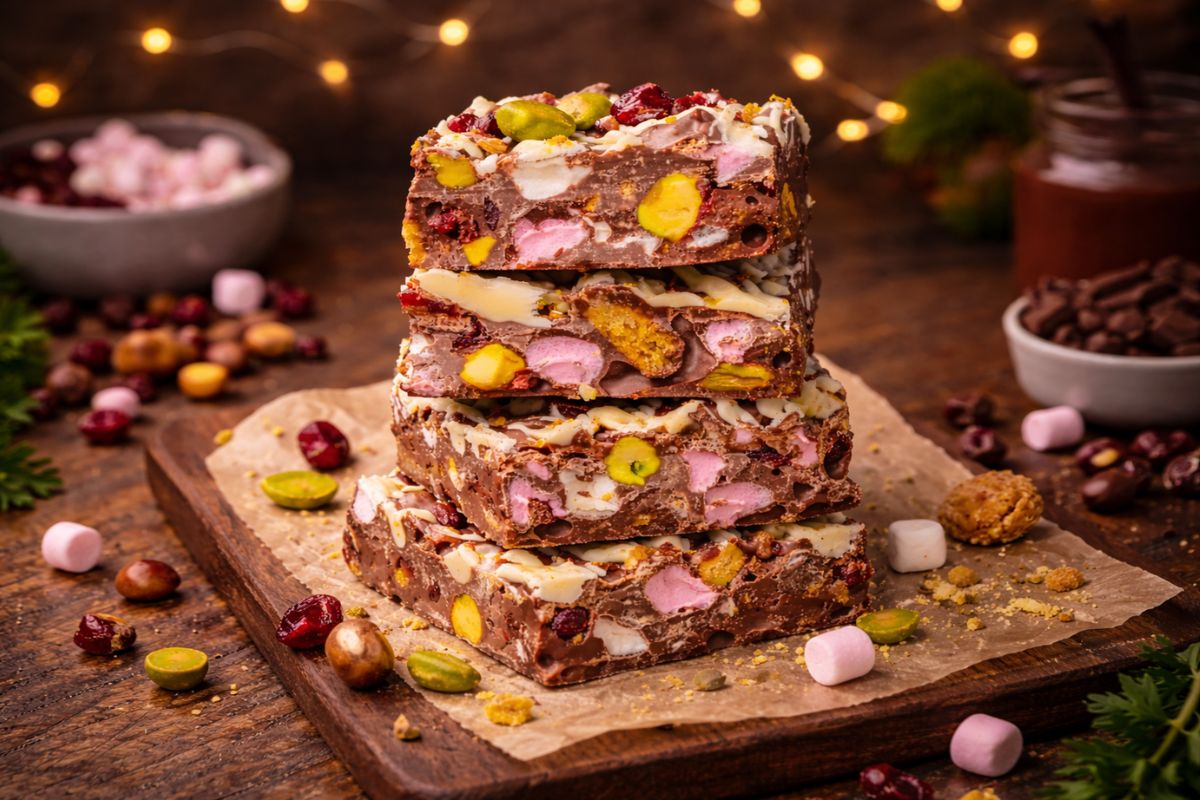
Nobody wakes up on a Tuesday and thinks today is the day for serious baking. Rocky road though? Rocky road absolutely gets made on a Tuesday. Or a Sunday. Sometimes a random Wednesday when there are three digestives rattling around in the tin and half a bag of marshmallows left over from something nobody can quite remember.
That is genuinely the whole appeal.
The rocky road recipe does not demand anything from you. No stand mixer. No temperature probe. No specialist ingredients that require a separate trip somewhere. Just whatever is already in the cupboard and about ten minutes of actual effort. And yet it comes out looking like something sitting behind glass in a Costa with a £4.50 price tag on it.
Right now in March 2026, it is sitting near the top of Google UK sweet treat searches, which feels completely right. But people are not just making the straightforward classic version anymore, either. Biscoff spread is going in. Crunchie bars. Salted popcorn. Turkish delight. The basic fridge cake has quietly reinvented itself into something people are actually proud to photograph, and honestly, it deserves the attention.
So, here’s everything worth knowing.
What’s Actually In A Classic Rocky Road (And Why Each Bit Matters)
Start with the basics. Chocolate, butter, golden syrup. That is the foundation and nothing else is needed at this stage.
Melt them together slowly. And ‘slowly’ is really carrying that sentence, because turning the heat up too high is almost always where it goes wrong. The chocolate seizes up, goes grainy and dull, and looks genuinely unpleasant. There is no rescuing it at that point. Low heat and a bit of patience – that is the whole job.
The golden syrup is not just there to add sweetness either. It keeps the finished chocolate mixture slightly soft once set, rather than turning into something with the texture of a pavement tile. Leave it out or cut the amount down and the difference is obvious the moment a knife touches it. The blade skids, finds no grip, and then the whole thing just cracks apart into one jagged, uneven lump instead of a clean square.
Every single time, without fail. For the chocolate itself, most British bakers choose Bournville or a 70% dark bar. Bournville is reliable and widely available. Something like Lindt 70% gives a more complex, slightly bitter edge that balances all the sugar coming in from the syrup and marshmallows.
Mary Berry, famously, uses a 50/50 mix of milk and dark in her honeycomb version on The Happy Foodie, and that’s a genuinely smart call. You get richness without the whole thing becoming oppressive.
Then come the biscuits. McVitie’s Digestives are the traditional choice. Now here’s where many people quietly ruin it—they go in with a rolling pin and turn everything to fine, sandy dust. Don’t. The goal is a mix of bigger chunks (roughly 50p-coin size) and a bit of rubble. That contrast between the clean snap of a larger biscuit piece and the softer, chewier bits around it is what makes a good rocky road feel interesting in the mouth rather than just dense.
Mini marshmallows last. And they go in after the chocolate mixture has cooled down for at least five to ten minutes. This is not optional advice. If the mix is still too hot, the marshmallows just melt into it, turning into grey, stringy streaks. Nobody’s posting a photo of that.
ALSO READ: How to Cook Ricotta Cheese for Lasagna With Spinach Properly
The Biscoff Thing — Why It’s Everywhere And Whether It’s Worth It
If you’ve been anywhere near a British bakery in the last couple of years, you’ll have noticed Biscoff in everything. Cheesecakes, brownies, waffles. And yes, obviously, rocky road.
The Biscoff rocky road has genuinely taken off. It started appearing in independent coffee shops, then Costa, and now everyone’s making it at home because – as one home baker noted on Something Sweet Something Savoury — a whole batch costs a fraction of what a tiny square goes for in a café.
The way it works: swap your digestives for Lotus Biscoff biscuits, and melt a generous portion of Biscoff spread into your chocolate base alongside the butter and syrup. The spread adds a spiced, almost caramel-like depth to the chocolate that’s hard to explain until you’ve tasted it. It also keeps the finished slab slightly softer, which most people prefer.
One thing worth noting — if you’re using white chocolate (which pairs brilliantly with the Biscoff flavour because the milk chocolate can sometimes overpower it), do not add golden syrup to the mix. As Jane’s Patisserie discovered through trial and error, white chocolate and golden syrup have a tendency to split and go strange. Use the Biscoff spread as your binding agent instead.
Keep the heat low throughout. If the mixture starts bubbling at all, take the pan off the heat immediately. White and milk chocolate both have lower melting points than dark and they’ll turn into an oily mess if they overheat.
Mary Berry’s Honeycomb Version: Still One Of The Best Going
This one has been floating around for a few years and keeps coming back, which usually means something is working.
The swap is straightforward. Ditch the marshmallows and break in chunky pieces of honeycomb toffee instead. Crunchie bars do the job perfectly, or there are plain honeycomb pieces in most supermarket baking aisles, if that is easier. What comes out the other end is a noticeably different bar. More texture, more depth, and a proper butterscotch crunch running through it that the classic version just does not have.
One thing worth knowing before going down this route, though. Honeycomb and fridges do not get along well over time. The moisture slowly gets to it, kills the snap, and leaves it slightly soft and tacky in a way that is difficult to come back from. So if making this version, aim to get through it within three or four days. And do not leave it sitting uncovered in the fridge overnight.
It will not survive that. Worth it though. Absolutely worth it.
ALSO READ: How to Cook Ricotta Cheese for Lasagna With Spinach Properly
A Few Tips That Actually Make A Difference
- Press it down properly. Once the mixture is in the tin, use the back of a spoon and really compact it into the corners. Any air pockets will show up as crumbly, unsatisfying gaps when it’s cut.
- The vegetable oil trick. A teaspoon of neutral oil (sunflower, vegetable) stirred into the chocolate as it melts makes the finished slab easier to slice cleanly without cracking. It also gives the surface a slight sheen that looks more polished.
- Hot knife method. For those bakery-style straight-edged squares: dip a sharp knife in just-boiled water and wipe it dry between every single cut. It sounds fussy, but it takes thirty seconds, and the difference is genuinely noticeable.
- Don’t rush the set. Two hours in the fridge minimum. Four is better. Overnight is ideal. Cutting into it too early is the most preventable mistake there is and yet it happens constantly.
- Icing sugar on top. Before serving isn’t just for looks. It takes the sharp edge off the chocolate richness and makes the whole thing feel a bit more complete.
Making It Vegan In 2026
Most big supermarkets stock vegan marshmallows now as a matter of course. Tesco, Sainsbury’s, Waitrose, all of them. Freedom Mallows and Dandies are the two worth looking for specifically, as both hold up well in a cold set rather than turning strange once the chocolate firms around them.
Swap the butter out for Vitalite or Flora Plant, grab 70% dark chocolate (most are vegan anyway but worth a quick glance at the label for milk solids just to be sure), and you’ve got a fully vegan rocky road without any compromise on texture.
How Long Does It Keep?
Standard rocky road keeps well in an airtight container in the fridge, up to two weeks without any issues.
The honeycomb version is shorter. Three to four days is about the limit before the texture starts going in the wrong direction.
Freezing works better than most people expect, too. Wrap individual squares in baking parchment, then foil, and they will keep for up to three months. Defrost in the fridge overnight and they come back almost exactly as they went in.
It is worthwhile to make a double batch for this reason alone.
ALSO READ: The Art of Cooking The Perfect Corned Beef Hotpot That Never Lets You Down
Frequently Asked Questions
Q1. Why Does The Chocolate Crack When Cutting?
Almost always comes down to not enough golden syrup or leaving it out completely. The syrup stops the set chocolate going fully rigid. Adding a small splash of vegetable oil helps as well. Use both together and the cracking mostly stops being a problem.
Q2. Can White Chocolate Be Used As The Base?
Yes, but it needs a bit of care. White chocolate melts at a lower temperature than dark and will seize quickly if it gets too hot or picks up even a small amount of water. It works better in a Biscoff version where the spread does most of the binding work, or just drizzled over a dark chocolate base as decoration rather than carrying the whole thing.
Q3. Is It Gluten-Free?
Not in its standard form. But swapping McVitie’s for a certified gluten-free digestive alternative keeps everything else the same. Schär makes a decent option.
Q4. Can It Be Made Without Marshmallows?
Definitely. The marshmallows add chew, not structure. Glacé cherries, Turkish delight, dried cranberries, or simply extra biscuit all work as alternatives. The slab holds together fine without them.
Q5. What’s The Best Tin Size?
A 20cm square tin gives a solid depth that slices well. A 23 cm tin produces slightly thinner bars. Either is fine. Don’t use a larger tin unless you’re doubling the quantities — the slab will be too thin and fragile.
Q6. Can The Recipe Be Made In Advance?
Yes, and it’s actually better for it. Making it the day before means it’s had a full overnight set in the fridge, which gives cleaner slices and a better texture throughout. Ideal for taking somewhere the following day.
The rocky road recipe has been around long enough that everyone thinks they know it. But there’s a real gap between a rough, slightly oily tray of it knocked out in a hurry and one that’s properly made — right chocolate, proper crunch, clean slices, the works. The difference isn’t skill. It’s just knowing which corners aren’t worth cutting.
That’s it, really. Go make some.
Sources & References
- BBC Good Food: Easy Rocky Road Recipe – The foundational UK metric for the classic fridge cake, featuring the dark chocolate and golden syrup base.
- The Happy Foodie: Mary Berry’s Honeycomb Rocky Road – The definitive guide for the honeycomb-toffee variant using a milk and dark chocolate blend.
- Jane’s Patisserie: Biscoff Rocky Road – The original viral source for the white chocolate and Biscoff spread binding method.
- Jamie Oliver: Rocky Road Megamix – Expert advice on adding fruit like cherries and cranberries to balance the sugar.
- The Baking Explorer: Vegan & Dairy-Free Rocky Road – Testing on how vegan marshmallows react to plant-based fats.
- Macmillan Coffee Morning: Official Rocky Road Charity Bake Guide – Tips on portioning and allergen labelling.
Disclaimer: This article is intended for informational purposes only and does not constitute professional culinary or dietary advice. The content is not meant to promote any specific brand or product. Readers should use their own discretion and judgment when preparing recipes. We are not responsible for any outcomes resulting from the use of this information.
Recommended