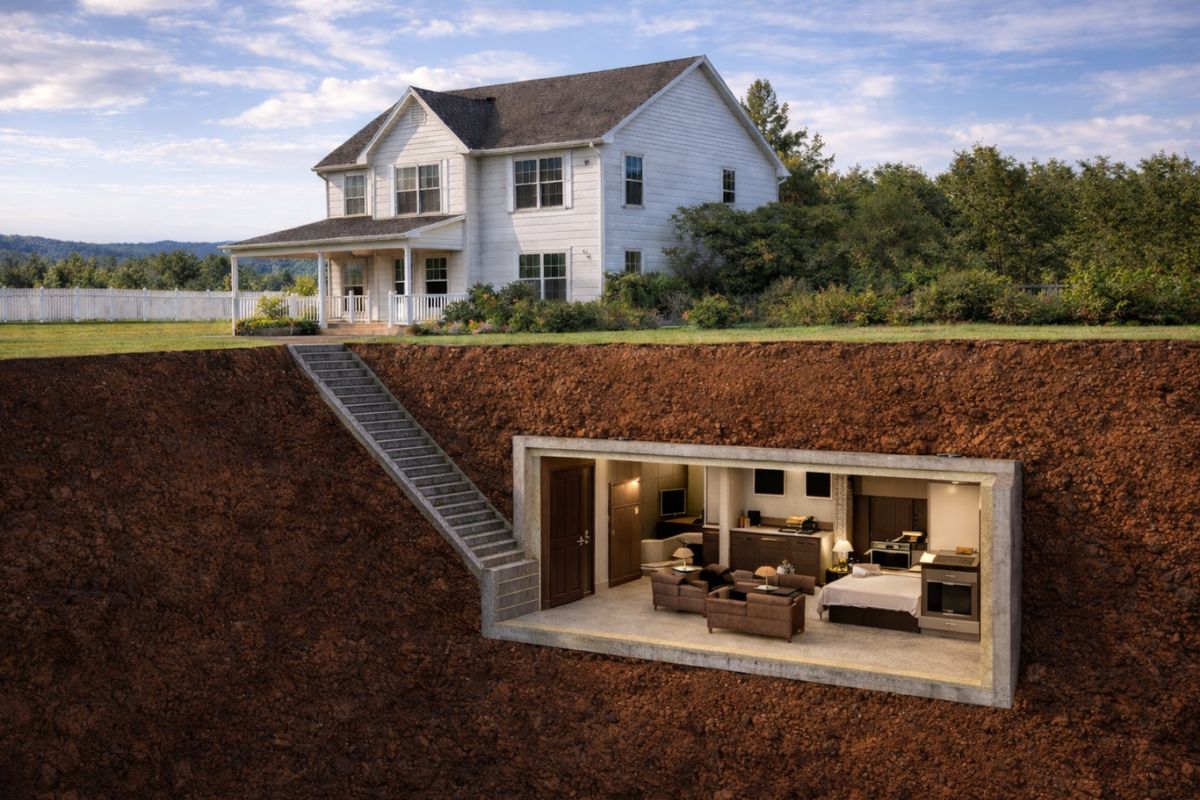
The ultra-wealthy aren’t just buying yachts and private islands anymore. In 2026, the real flex is total invisibility. While the rest of the world has been obsessed with skyline views and floor-to-ceiling glass, a specific subset of the global elite has spent the last few years digging.
And now here—I’m talking about a colossal, stealthy shift in high-end architecture wherein “curb appeal” has finally been done in by something even more strategic: asset camouflage.
It’s late February 2026, and the talk in top-tier architecture firm boardrooms has moved well beyond basic panic rooms. We’re seeing the rise of residential nuclear bunkers—the “luxury vault” trend—as survivalism is rebranded as an elegantly appointed “geopolitical hedge.” If you have £20m to throw around, you’re no longer creating a home—you’re erecting a self-sufficient ecosystem designed to survive more than 100 years of upheaval.
The Architecture Of Invisibility: Neo-Brutalism Underground
The most striking trend I’ve seen this year is the move toward “The Invisible Fortress.” Gone are the days of the obvious backyard steel hatch. Today’s top-tier builds, like the much-discussed Onyx Fault project, are literally carved into granite cliff faces. These aren’t just holes in the ground; they’re masterclasses in Neo-Brutalist design.
Using board-formed concrete and natural stone, these estates are built to blend into the topography so perfectly that you could walk right over them without knowing they exist. This isn’t just for the sake of aesthetics. It’s about thermal mass efficiency and ballistic-grade security.
By burying the residence, owners are getting natural geothermal regulation that keeps the “vault” at a steady temperature regardless of what’s happening on the surface. It’s a bit like the old British “Chain Home” radar bunkers from the Second World War, but with Italian marble and a wine cellar that would make a sommelier weep.
ALSO READ: British ISA: The £5,000 Plan That Got Binned Before It Even Started
Psychology Over Survival: The Wellness Circuit
Honestly, the biggest challenge of living underground isn’t the air—it’s the mind. Nobody wants to spend six months smelling like tinned beans and damp concrete. That’s why 2026 bunkers are being designed with a heavy focus on “Subterranean Wellbeing.”
I recently spoke with a consultant who worked on the Aerie project—a staggering $300 million members-only bunker complex due to fully open its Virginia location this summer. They’re installing what they call Digital “Windows”. These are high-definition LED walls that simulate 24-hour day/night cycles with scarily realistic outdoor scenery. If you want it to be a sunny Tuesday in the Maldives while a blizzard or a fallout cloud rages outside, you just flick a switch.
Then there’s the Contrast Therapy Circuit. We’re talking private spas with ice plunges, saunas, and hyperbaric chambers. The idea is to manage the intense psychological stress of isolation through physical “shocks” to the system. It’s survival, yeah, but it’s survival wrapped in a five-star hotel experience.
The Rise Of The “Subterranean Secession”
There’s a bit of a cynical joke in the industry that the super-rich are essentially “seceding” from the world they helped create. According to recent market analysis by Coherent Market Insights, the global nuclear bunker market is set to hit nearly $2 billion this year. This isn’t just a fringe hobby for “preppers” anymore. It’s a legitimate asset class.
| Shelter Type | Estimated Cost (2026) | Target Audience |
|---|---|---|
| Prefabricated Modular | £40,000 – £150,000 | Middle-class “Preppers” |
| Custom Residential Vault | £250,000 – £2,000,000 | Successful CEOs / Tech Founders |
| Ultra-Luxury Membership | £15,000,000+ | The Global 1% / Elites |
The most exclusive of these is Aerie, which SAFE (Strategically Armoured & Fortified Environments) has developed for a mere 625 members. Each suite can be modelled as a private residence—some reaching 20,000 square feet—all connected to an ecosystem of fine-dining restaurants and AI-powered medical suites. It’s a community for those who imagine the “Day After” as just another Tuesday, provided the robotic staff is still functioning.
Microgreens And Robots: The Self-Sustaining Core
You can’t stay underground forever if you’re relying on a pantry full of dried pasta. The 2026 trend has pivoted hard toward Hydroponic Gourmet Gardens. We’re seeing vertical farms integrated directly into the kitchen architecture. These systems provide fresh microgreens, tomatoes, and even strawberries, using sophisticated irrigation and calibrated light cycles.
But here’s the crazy part: the medical side. Modern bunkers are now shipping with MediShield units. These are essentially mini-hospitals staffed by AI-managed diagnostic tools and even robotic assistants capable of nutrient delivery via IV therapy.
It sounds like something out of a sci-fi flick, but for a “moderately successful CEO” looking to protect their family, it’s becoming the new standard. As reported by Domus Web, the bunker has moved from military necessity to an architectural grammar of absolute comfort.
ALSO READ: Artificial Intelligence Integration In Modern Organisations: Benefits And Challenges
Practical Questions (FAQs)
Q1. Are These Residential Nuclear Bunkers Actually Nuclear-Proof?
Most modern high-end builds are rated as NBCET sanctuaries. That stands for Nuclear, Biological, Chemical, Electromagnetic Pulse, and Technological attack. They use specialised CBRN filters and massive blast doors, though total “proof” depends on the proximity to a strike.
Q2. Can I Retrofit An Existing Basement In The UK?
You can, but it’s a nightmare. British planning laws are a bit of a faff, and the structural reinforcement required for a “Luxury Vault” usually makes it cheaper to dig a new one from scratch.
Q3. How Do They Handle Electricity?
Most use a combination of redundant diesel generators (with massive fuel reserves) and geothermal energy support. Some even use biomass accumulators to keep the lights on for up to a year without surfacing.
Q4. Is It Just For The Rich?
While the “Luxury Vault” trend is aimed at the 1%, modular steel shelters have become much more attainable. You can get a basic, safe unit for the price of a mid-range Tesla.
At the end of the day, Italian marble can only take you so far in hiding the simple fact that you’re living in a really expensive residential nuclear bunker. But in a world that feels noisier and more unpredictable each day, you can see why the quiet, controlled silence of an underground estate might feel like the ultimate luxury. It’s the ultimate “just in case” purchase.
Anyway, it makes you wonder: if the people at the top are all digging down, maybe we should at least be looking at the quality of our basement waterproofing? Just a thought.
References & Sources
- The Panic Room Company. (2026). Safe rooms & protected areas for residential & commercial clients worldwide.
- Coherent Market Insights. (2025, November 9). Nuclear bunker market size, share and analysis, 2025–2032.
- Domus. (2025, November 21). Luxury bunkers are becoming the super-rich’s new architectural trend. Domus Web.
- LoveProperty. (n.d.). Tour the billionaire bunker Aerie: The ultimate underground survival retreat.
Disclaimer: This article is provided for informational purposes only and does not constitute financial, architectural, security, or investment advice. The content is not intended to promote, endorse, or advertise any specific product, company, or service mentioned. Readers are advised to conduct their own research and seek professional guidance before making any related decisions.