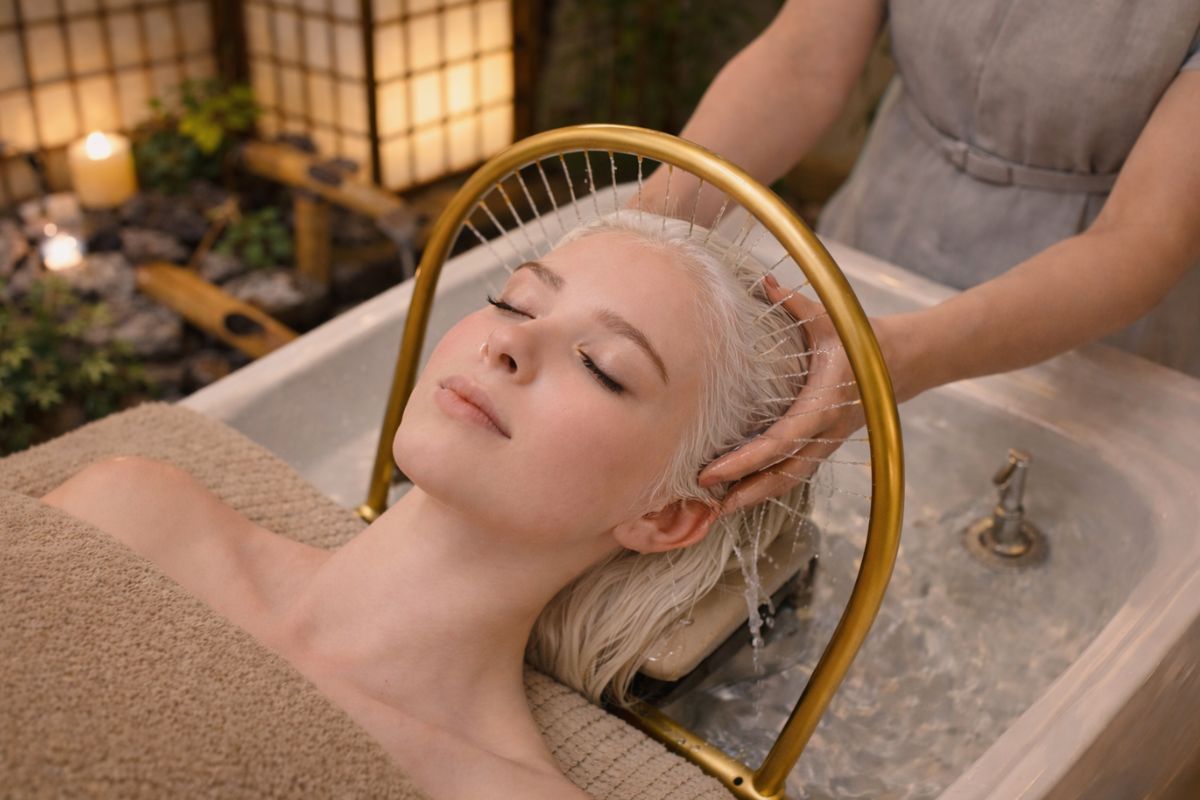
As of March 2026, a Japanese Head Spa is a holistic scalp treatment that combines deep follicular cleansing with therapeutic massage and “halo” water therapy. Unlike a standard haircut and wash, this ritual focuses on “scalp facials” to improve hair growth and nervous system health. While professional sessions are booming in cities like London and Manchester, the rise of professional-grade DIY scalp tools has made it possible to recreate this viral “waterfall” relaxation at home.
What is the Japanese Head spa?
Close your eyes for a second. Picture a warm, steady stream of water pouring around your hairline like a halo as someone kneads away a week’s worth of stress out of your scalp. It seems unreal, doesn’t it? But for thousands of people across Britain this month, it is just a regular Tuesday afternoon. The Japanese Head Spa has graduated from the “cool video I saw on TikTok” category and become a genuine wellness need.
When I first walked into a specialised studio in London last year, there was the scent of hinoki wood and camellia oil in the air. My scalp was tight—that dull throb you get from having a ponytail on and just staring at a computer for eight hours. An hour and a half later, I left with more than clean hair. It was like I’d had a full-body reset. In truth, it’s the mental clarity these treatments give that is really the secret. It’s not just vanity; it is giving your brain a literal breather.
ALSO READ: Can a Cold Plunge Really Help You Burn Body Fat? – Explained
Beyond the Wash: What’s Really Happening?
What, then, is the real difference between a £15 blow-dry wash and an upmarket Japanese head spa? It’s all about the skin. We spend a lot of money to buy serums for our faces, but we tend to think of our scalps as an afterthought. In 2026, the trend has shifted toward “Scalp Facials.”
Therapists now use micro-cameras to show you your hair follicles up close. Seeing the buildup of dry shampoo and pollution on a big screen is a bit of a wake-up call, frankly. The treatment uses a mix of pressure point massage, steam, and that iconic “halo” water ring to deeply clear out the gunk.
According to the SpaSeekers 2026 Trends Report, interest in these specialised scalp treatments has surged by 48% this year alone. It’s officially the “it” treatment from Leeds to Oxfordshire.
The Comparison: Why a Head Spa Isn’t Just a “Wash”
| Feature | Your Standard Salon Wash | The Japanese Head Spa Ritual |
|---|---|---|
| Primary Goal | Surface hygiene | Deep “Scalp Facial” & Stress Reset |
| Tool Kit | Fingers & a showerhead | Halo Water Ring, Steam, & Jade Combs |
| The “Vibe” | Chitchat & rushing | Total silence, chimes, & feathers |
| Follicle Fix | Clears daily oil | Removes years of waxy sebum & pollution |
| Nervous System | No real impact | Lowers cortisol & triggers ASMR |
Creating the Vibe: Japanese Head Spa: Top DIY Scalp Tools (UK Edition)
Look, we can’t all drop £120 every week at a salon. The good news is that the UK market has been flooded with some incredible gear recently. If you want to try this at home, you need more than just a bottle of shampoo.
The 2026 must-haves for an at-home ritual include:
-
Kyoto Spa Heads: These are dual-shower attachments you can actually fit onto your own sink. They mimic that “waterfall” flow that looks so satisfying in videos.
-
Jade and Rose Quartz Combs: Used for “Scalp Gua Sha.” They’re brilliant for shifting that heavy, “clogged” feeling and helping with lymphatic drainage.
-
The Octopus Tool: A multi-pronged jade massager that looks a bit weird but works wonders for lifting the scalp.
-
Electric Scalp Scanners: You can now buy tiny cameras that plug into your iPhone. Checking your own follicles at home is a bit addictive, if I’m being honest.
The Japanese Head Spa Co. has even started selling “Starter Packs” for around £50, which is a total bargain compared to salon prices.
ALSO READ: Who Is Hettie Jago Married To? A Look At Her Marriage, Children, And Life In London Home
Why The UK Is The Perfect Place For This
You might wonder why a Japanese tradition has landed so firmly in British culture. Well, look at our weather. The damp, cold UK winters and the hard water in places like London wreak havoc on our hair. Our scalps get dry, itchy, and stressed.
New studios like Aura10 in the Midlands and Moon Skin Ltd. have popped up to address exactly this. They don’t just wash your hair; they use tuning forks and chimes to “reset” your nervous system before they even touch the water.
It’s a sensory experience. Some places even use ostrich feathers for light stimulation on your forehead. It sounds a bit “woo-woo,” but once you’re under that warm water, you won’t care. It’s pure bliss.
How to Do It Yourself (The 15-Minute Method)
If you’ve picked up a few items from the top DIY scalp tools (UK edition) list, here is how you actually use them.
-
Open the Pores: Use a warm steam cap or a hot towel for five minutes.
-
The Scrape: Run a jade comb in long sweeping motions from your forehead to the nape of your neck.
-
The Deep Clean: Apply a scalp oil (camellia is the classic choice) and use an electric silicone massager in circular motions.
-
The Rinse: If you have a waterfall attachment, let the water run over your hairline for at least three minutes without moving.
The Economics of Self-Care
Is it worth the hype? If you look at the KBH Training Academy kits, people are spending anywhere from £45 for a basic set to over £1,000 for a portable head spa bed. That’s a lot of dosh. But when you consider that a Japanese Head Spa is basically a massage, a facial, and a hair treatment rolled into one, the math starts to make sense.
Anyway, the real proof is in how you feel the next day. My hair has never had more “bounce,” and my “tension headaches” have basically vanished. It’s one of those rare trends that actually delivers on the promise.
FAQs
Q1. Does a Japanese Head Spa help with hair growth?
Yes, but it’s not magic. Clearing out the follicles and improving blood flow via massage would create a perfect “soil” for your hair to grow. Think of it like weeding a garden.
Q2. Can I do this if I have hair extensions?
You need to be careful. The majority of therapists advise that a full treatment should not be done until your extensions have been removed, but you can still use the “halo” water and light massage.
Q3. How often should I go?
For most people, once a month is the sweet spot. If you’re doing the DIY version at home, you can complete the massage portion a few times each week.
Q4. What if I have a very sensitive scalp?
Always tell your therapist first. The 2026 professional kits now include specific serums for sensitive skin, using ingredients like cherry blossom and aloe.
Honestly, if you haven’t tried Japanese head spa yet, you’re missing out on the best nap of your life. Whether you book a session at a posh London clinic or just grab a jade comb and do it in your bath, your head will thank you.
Sources & References
-
SpaSeekers. (2026). The spa trends report 2026: UK beauty insights.
-
Japanese Head Spa Co. (2026). Professional tool starter pack (14 items).
-
The Online Beauty Courses. (2025). Japanese head spa course kit: Training resources.
-
KBH Training Academy. (2025). Japanese head spa products: UK scalp spa supplies.
Disclaimer: This article is published strictly for informational and educational purposes only. The content does not intend to promote or endorse any specific product, service, or brand mentioned in the article. Readers should conduct their own research or consult qualified professionals before trying any treatments, tools, or wellness practices discussed above.
Recommended