I’ve been getting my hands dirty in the garden for more years than I care to think about, so I’ve seen just about every trend come and go. One year it’s vertical hydroponics, the next “moon planting”. But the one crop that’s really rocked my world, and from speaking to other gardeners up and down this island, many others’ besides, is sweet potato. We were all told for years that they simply wouldn’t work here. No one truly knows how to grow sweet potatoes. Too cold, too wet, too much like hard work. Well, let me tell you: that’s just a bunch of hooey.
I mean, listen, I remember my first attempt back in the day. I had bought a supermarket tuber, stuck it into a jar of water and waited. And waited. Nothing happened except a bit of slime and a smell that I’m sure still haunts that kitchen corner. I nearly gave up. But then I realised the “secret” isn’t in the potato itself but in the patience and the prep. In February 2026, with our summers getting notably stickier and the cost of “luxury” veg at the local Waitrose reaching eye-watering levels, there has never been a better time to learn how to grow sweet potatoes.
The “Slip” Secret: Why Everything You Know About Spuds Is Wrong
The first thing you have to understand—and this is where most people trip up—is that sweet potatoes aren’t actually potatoes. They’re members of the morning glory family. Because of this, you don’t just chop one up and chuck it in a hole like you do with a King Edward. You need “slips”. These are the leafy green shoots that sprout from the mother tuber.
Anyway, here’s what I do now so as to escape the “jar of doom.” Eight to 10 weeks before the last frost (which means right about now), I grab an organic sweet potato. It has to be organic because the regular ones are often sprayed with stuff to prevent them from sprouting. I then lay it to one side in a tray of moist, peat-free compost, half-buried as if sunbathing.
The crazy part is the heat. These things are tropical. If you don’t have a heat mat, place sweet potatoes on the top of the fridge or near a radiator. I have seen people use airing cupboards too. You want a good solid 25 degrees Celsius. When those purple-green shoots are around six inches, you twist them off and put them in a glass of water. Within a week, you will have a forest of white roots. That, my friends, is a plant ready for the world.
ALSO READ: How to Cook Ricotta Cheese for Lasagna With Spinach Properly
From Windowsill To Veg Patch: The 5 Steps To Success
Once you have those roots, you can’t just throw sweet potatoes to the wolves. Here is the boots-on-the-ground process I actually use each year to make sure they don’t go into shock.
- Potting Up: When your rooted slips are ready, pot them in 9 cm (3 in) pots of good multi-purpose compost. Let them sit on a sunny windowsill.
- Hardening Off: About two weeks before you want to plant out, begin setting the pots outside and taking them back in at night. It’s a training camp for plants.
- Warming The Bed: Sweet potatoes must have warm toes. A week before planting, spread black plastic or a heavy-duty black membrane over your soil to trap the sun’s heat.
- The Deep Plant: When it’s planting time at last (that, for me in the UK, is generally June), dig a hole 5 inches deep. Plant the strip up to its top leaves. New tubers will form at each leaf node you bury.
- Watering And Feeding: Soil should be kept moist but not wet. When they begin romping away in early August, feed them fortnightly with high-potash liquid feed (tomato food is ideal).
Dealing With The British “Summer”
Let’s face it: our climate is a capricious beast. Sweet potatoes hate the cold. If you plant them out too early, they’ll turn black and die before your morning brew is finished. You have to wait until the soil reaches a minimum of 18°C. In the UK, that usually means June.
I’m here to say the “Mound Trick” has been a lifesaver. Instead of planting in flat ground, I make mounds or ridges out of sandy, loose dirt about 12 inches high. Why? The reason for this is that the sun warms mounds more quickly. It traps the heat like a little sauna for your spuds.
But here’s what I found out the hard way: don’t over-fertilise. One year, I got a little heavy-handed with the chicken manure. I had vines that were auditioning for Jumanji — big, lush and everywhere — but when I dug them? Tiny little stringy roots. It was heartbreaking. Stick with that potash feed once they are established. They want to work for their dinner.
The Great Grow Bag Revolution Of 2026
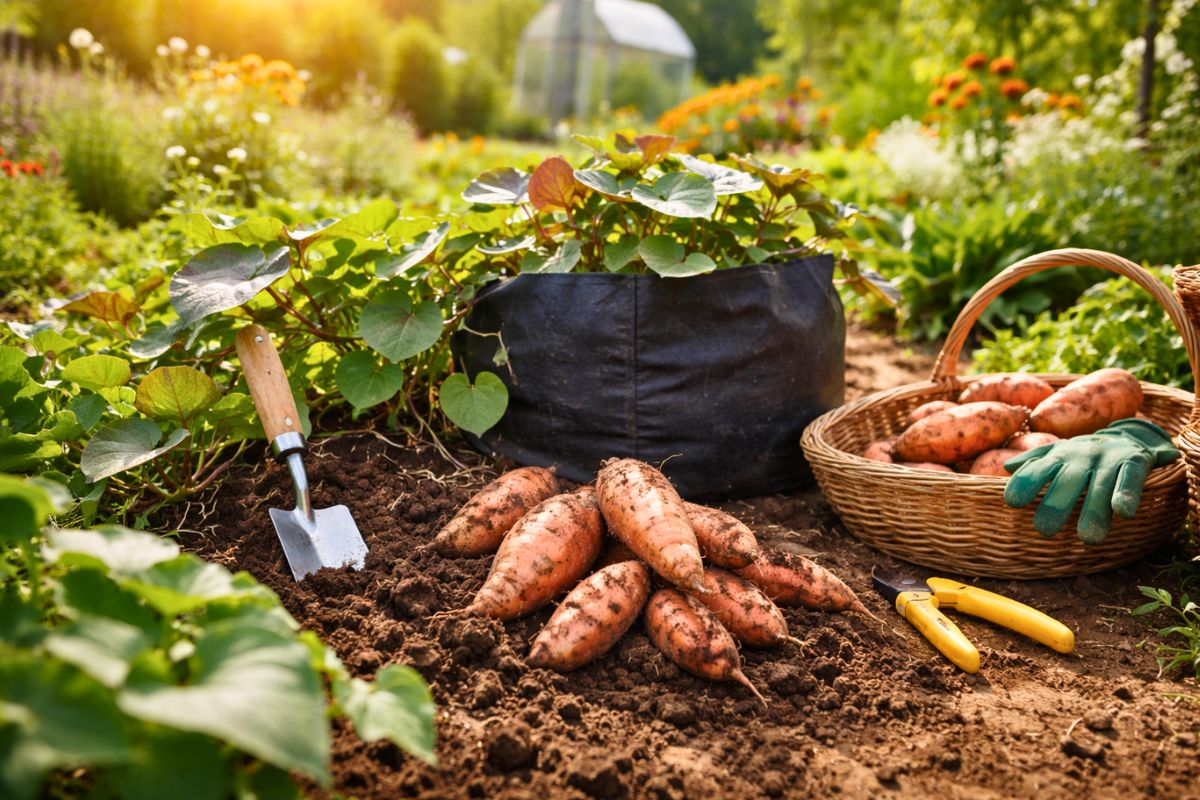
If you’re tight on space or your garden soil is basically heavy clay (the enemy of all root veg), don’t panic. How to grow sweet potatoes in containers is actually my preferred method these days. I use 30-litre grow bags. They’re brilliant because you can move them into the sunniest spot on the patio, and the black fabric keeps the roots nice and toasty.
The real beauty of the bag method is the harvest. No more accidental “stabbing” of the tubers with a garden fork. When the leaves turn yellow (probably in October sometime), you just tip the bag out onto a tarp.
It’s like a treasure hunt. I once did this with my youngest, and the expression on her face when a huge shiny orange “Beauregard” plopped out of the dirt last year made it all worthwhile.
The “Hidden” Step: The Cure
Now, here is the part most people ignore, and it’s why their homegrown sweet potatoes taste like flavourless cardboard. You can’t eat them right out of the ground! You can, of course, but you’ll regret it.
The sugars have yet to form in freshly dug sweet potatoes. They need to “cure”. As soon as you unearth them, dust the dirt off (don’t rinse!) and set them in a warm, humid spot for at least 10 days. I use a spare bedroom using a humidifier, but a sunny greenhouse is also an option. Not only does this process cause the nicks in the skin to heal, but it also begins the enzymatic process of converting starch into sugar. It’s the difference between a “meh” potato and a “wow” potato.
ALSO READ: Mary Berry Leek and Potato Soup: The Food Recipe I Keep Coming Back To
Pro-Tips For A Bumper 2026 Harvest
- Avoid The “Nitrogen Trap”: Overdo it on compost or manure and you’ll have an abundance of foliage with no tubers. Stick to sandy-loam soil.
- The Flower Pot Trick: If you plant out in a heatwave, cover your new slips with upside-down flower pots for the first three days. It prevents them from getting “baked” while their roots are trying to establish themselves.
- Harvest Timing: According to the 2026 RHS Veg Guide, you want them out before the soil temperature drops below 10°C, or the tubers will rot in storage.
- Potash Is King: Side-dress your plants with wood ash or a high-potash fertiliser in early July to get those tubers to swell.
A Final Word From The Trenches
What I love most about gardening is not the “perfect” harvest; it’s the story of the season. Raising sweet potatoes is a lot like running a marathon. There’s the early spring rush of activity, the slow-motion crawl of summer vines, and that last frantic sprint to outrun first frost of autumn.
Anyway, the point here is that you might as well try. Even if you end up with just a few spuds the first time around, there’s nothing quite like roasting something you grew from a tiny shoot on your windowsill. It is hard to beat. Just make sure to keep them warm and not drown them in nitrogen. For the love of all that is holy, do let them cure before you bake them.
I don’t know about you, but I’m off to check on my slips. Have you started your “mother” potato yet, or are you still weighing up which variety to pick?
Frequently Asked Questions
Q1. Can I Grow Sweet Potatoes From A Supermarket Tuber?
Honestly? It’s a risk. Most are treated with sprout suppressants. If you’re going to try it, make sure it’s organic and give it a good scrub first. But for the best results, buy “virus-free” slips from a reputable UK supplier.
Q2. How Many Sweet Potatoes Do I Get Per Plant?
In a decent UK summer, you’re looking at about 3 to 5 good-sized tubers per slip. It’s not a massive haul compared to maincrop white potatoes, but the flavour is on another planet.
Q3. What Are The Best Varieties For The UK In 2026?
Look for ‘Beauregard Improved’—it’s the classic for a reason and handles our shorter seasons well. If you want something fancy, ‘Erato Violet’ has stunning purple flesh and is packed with antioxidants.
Sources & References
- Royal Horticultural Society (2026). “Sweet potatoes: grow your own.”
- BBC Gardeners’ World (2025). “How to grow sweet potatoes: planting slips and harvesting tips.”
- Old Farmer’s Almanac (2026). “Sweet Potatoes: Planting, Growing, and Harvesting Sweet Potatoes.”
- Suttons Gardening Hub (2024). “How to grow sweet potatoes: top varieties for shorter growing seasons.”
- Garden Organic (2025). “Sweet Potato: Propagation and post-harvest curing techniques.”
Recommended